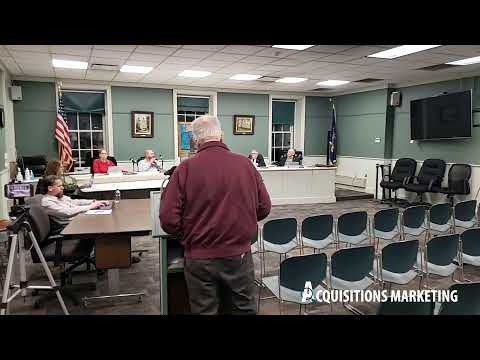
Goshen board hears expert testimony, extends public hearing on temporary moratorium for battery storage
Loading...
Summary
Goshen’s Town Board continued its public hearing on Introductory Law No. 9 (a proposed temporary moratorium on battery energy storage systems), heard industry and HazMat testimony after a nearby Warwick fire, and voted to extend the hearing to Jan. 8 while requesting technical analyses and written responses from applicants and experts.
Goshen — The Town Board continued a public hearing on Introductory Law No. 9 of 2025, which would place a temporary moratorium on battery energy storage systems (BESS), and voted to extend the hearing to Jan. 8 for further study.
Board members said recent battery fires in nearby Warwick and outstanding technical questions justify more research and public input before taking action. "I need a little bit more time to review all of the information because there's a lot of new information and new technology," one board member said during the meeting.
The hearing drew testimony from Terrence Nolan of New Leaf Energy, who outlined his company's proposed Harvey Road project and asked the board to exempt the pending application from a moratorium so the project can complete local planning steps. "We're going with the Tesla Mega Pack 2 XL," Nolan said, adding New Leaf was prepared to put money in escrow to pay for independent expert review of the design.
An outside HazMat expert, Daniel Murray of Energy Safety Response Group and a retired FDNY HazMat chief, described the Warwick incident and local response protocols. Murray said investigators suspect water intrusion into cabinets triggered the Warwick event and that specialized subject‑matter experts (SMEs) took over the scene once alerted. He reported preliminary air monitoring readings of about 4 parts per million carbon monoxide and 0.5 parts per million hydrogen cyanide, and said more detailed analysis was pending. "The fire department was essentially relieved from the scene around the 5 hour mark, and then the SMEs took over," Murray said.
Board members and members of the public raised technical and operational questions they want answered during any moratorium. The supervisor instructed staff to collect written material and asked New Leaf and other presenters to provide documentation on fire‑protection spacing, enclosure design, peer review results, and the origin of equipment. An enumerated list read into the record included fire causes (overcharge, internal short, water intrusion), electrical and arc‑flash risks, structural enclosure failure, environmental regulatory risks and disposal/recycling, insurance impacts, training and emergency management capacity, and cybersecurity vulnerabilities.
New Leaf warned a lengthy moratorium could jeopardize project incentives. "Depending on the length of the moratorium, if we're not able to proceed, we may lose the NYSERDA incentive, which is on a first come first serve basis," Nolan said.
The board did not adopt the moratorium at the Dec. 22 meeting. Instead, it voted to reopen the public hearing on Jan. 8, 2026, and requested written technical responses and supporting materials be supplied before that date.
What happens next: The board will review documents and expert reports submitted by applicants and third parties before resuming the hearing. If the board moves to propose or adopt a moratorium after that record is compiled, members said they will identify the specific categories of systems and projects affected and whether any pending applications will be carved out.