
Central Coast projects: free well testing, nitrate monitoring and consolidation models on display
Get AI-powered insights, summaries, and transcripts
Subscribe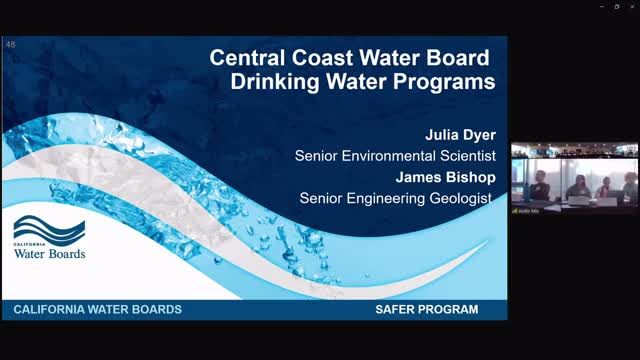
Summary
Central Coast regional staff and partners showcased free domestic-well testing, irrigated-lands nitrate sampling and multiple consolidation projects (Gatlin, Country Meadows, Echo Valley School, Springfield Road/Moss Landing) as examples of interim and long-term solutions delivered with SAFER support.
Regional staff and TA partners used the SAFER Advisory Group meeting to spotlight Central Coast projects that blend interim help and long-term consolidation.
Julia Dyer described the Central Coast Drinking Water Well Testing Program (centralcoastwelltesting.org), which has sampled more than 800 wells in seven years with an average exceedance rate near 45 percent for at least one primary contaminant, most commonly nitrate, arsenic and hexavalent chromium. She emphasized partnerships with the Community Water Center and county public-health agencies and provided guidance on where to download anonymized data.
James Fishman (Irrigated Lands Program) presented on on-farm sampling done in 2024: per-basin nitrate distributions show exceedance rates from about 28 percent to nearly 60 percent in sampled basins. Fishman said the program samples roughly 2,000 domestic wells and 3,300 irrigation wells per year and that an alternative water supply program (targeting nitrate from agriculture) is under development with draft regulatory language expected in 2026 and final requirements in 2027; the growers would fund the program with co-funding as needed.
Cal Water’s Albert Sanchez reviewed the Gatlin consolidation project — a multi-system consolidation involving 162 service connections and additional nearby small systems — and cited a $4.2 million grant for main and service-line work while additional funding for laterals is still being sought. Consultants Heather Bastian and Amy Bilson outlined a larger regional feasibility study that assessed 37 systems (~500 connections) at an estimated capital cost near $70 million, and described a more immediate Echo Valley School project addressing recurring arsenic spikes with pilot-treatment testing underway.
Community Water Center and local partners presented the Springfield Road/Moss Landing consolidation as a model: extensive resident outreach led to >95% domestic-well participation among included households; staff used technical-assistance funds to complete 100% design and procurement ahead of construction funding to accelerate timelines. Speakers described creative problem-solving on easements and mobile-home-park participation to prevent delays.
Ending: The meeting adjourned to a field tour where participants visited several of the projects summarized in the presentations.