Get Full Government Meeting Transcripts, Videos, & Alerts Forever!
Get email alerts on the Economic Development topic
No spam. Unsubscribe anytime.
EDA outlines childcare incubator, affordable housing plans and hotel timeline
Summary
EDA Director Lauren Deitz updated council on local childcare capacity shortfalls and a proposed 'childcare house' pilot, modular single-family homes through a housing partnership, a disappointed low-income tax credit non-selection for the Tapestry multifamily project, continued coordination with Solugen (construction planned for 2026), and a hotel developer’s request for a temporary unobligated TIF extension with benchmarks.
At Tuesday’s Marshall City Council meeting, Economic Development Director Lauren Deitz briefed council on several projects the city’s EDA is pursuing to address childcare and housing shortages and to keep local economic projects moving forward.
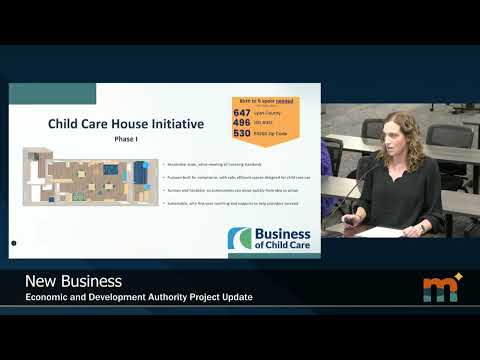
Deitz said a 2024 childcare strategic supply study found Marshall had about 418 licensed childcare spots but needed roughly 530 more, a gap the city views as significant. To address supply, the EDA voted to explore a partnership with Business of Childcare, a Minnesota-based nonprofit that builds and supports residential-scale childcare facilities. Deitz described the idea of a city‑owned, roughly 800-square-foot “childcare house” that would be licensure-ready and serve as an incubator: the provider would receive year‑one support from the partner organization and could later transition to its own space while freeing the incubator for another provider.
On housing, Deitz described outreach with the Southwest Minnesota Housing Partnership and UCAP. The partnership has proposed purchasing four EDA lots to site modular, three-bedroom, two-bath homes (about 1,500 square feet) with donated labor from a modular builder; the goal is to target 80–100% area median income affordability. The EDA is evaluating community land trust and other subsidy approaches and will await program funding decisions before finalizing the approach; placement is hoped for 2026.
Deitz also reported that a Tapestry multifamily application for low-income housing tax credits was not selected this cycle after a competitive round (35 non‑selected projects vs. 8 awarded). The developer plans to reapply; staff said the city’s score has been improving and they will adjust the application strategy for 2026.
On industrial and hotel developments, Deitz said Solugen (Bio Forge Marshall) remains slated to start construction in 2026 absent a prolonged federal loan negotiation; the company’s 2025 progress on customer and partnership recruitment supports that timeline. She also said Rebound Development is seeking an extension of unobligated TIF funding to complete franchise and investor commitments for a hotel near the Red Baron Arena, and staff recommended a temporary extension with specific benchmarks so the city can both allow the project time and retain flexibility to allocate the funds elsewhere if another opportunity emerges.
Council members asked what the city could do to improve competitive applications and whether benchmarks for TIF extensions should be firm; staff said they are pursuing additional expert review of applications and will bring back recommendations on benchmarks if council directs.
Deitz characterized childcare and housing as critical long-term EDA priorities and said staff will continue pursuing funding and partnership options while refining applications and project plans.