
Salem School Committee adopts reconfiguration 'scenario 4' after split vote
Get AI-powered insights, summaries, and transcripts
Subscribe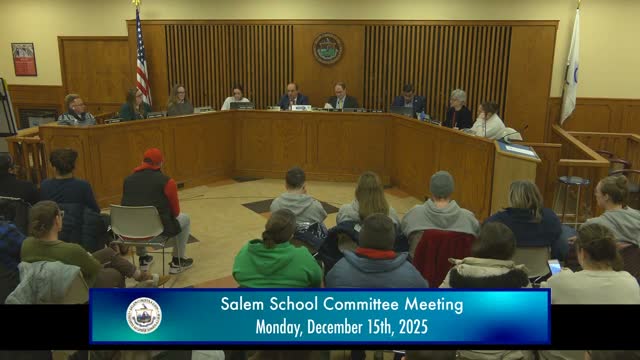
Summary
After hours of public comment and debate over two reconfiguration plans, the Salem School Committee voted 4–3 on Dec. 15, 2025 to adopt 'scenario 4,' a short‑term consolidation plan; the superintendent said transition teams and a detailed timeline will be presented in January.
The Salem School Committee on Dec. 15 voted 4–3 to approve a district reconfiguration labeled “scenario 4,” a short‑term consolidation plan meant to reduce near‑term costs while officials continue planning a larger district redesign.
The decision came after more than an hour of public comment and a lengthy committee debate over two competing approaches. Member Cruz initially moved to approve option 3 — a longer‑term reconfiguration that several members described as the committee’s preferred final configuration — with fiscal conditions and a phased implementation timeline. Cruz later amended the motion to remove the conditions. That motion failed on a roll‑call vote, 3–4. Member Cornell then moved adoption of scenario 4; that motion passed 4–3.
Why it mattered: proponents of scenario 3 said it would better align programs, buildings and equity goals in the long run. Opponents warned that scenario 3 would require moving more than 700 students in a single summer, risk losing staff and programs, and create logistical stress while the district is managing a $450 million high‑school construction project. Members who supported scenario 4 described it as a more measured step that could achieve budget savings with less immediate disruption.
Public comments set the tone. Lila Hauck, a parent at Carleton, told the committee the district had “ideas but no actual plan,” and warned a rushed reconfiguration would harm vulnerable students and staff: “Setting in motion a half‑baked plan to have the elementary schools in Salem reconfigured by August 2026…will cause such an expensive and stressful web of new logistical problems.” Megan McGough Christian, a Saltonstall parent, urged the committee not to move Bentley’s selective dual‑language program into central Salem in a way that would remove open‑enrollment options near the town center.
Committee debate focused on equity and logistics. Member Campbell and other educators warned a phased approach can extend uncertainty for teachers and families, while supporters of the longer plan argued delay would deny cohorts of children access to dual‑language instruction. Member Miranda highlighted data and family‑engagement feedback showing proximity matters for access to bilingual programs.
Next steps: The superintendent said the district would send a summary communication the next day, share leadership and transition‑team information by the end of the week, and present more specifics at the Jan. 5 meeting. He said the district plans to form both a transition team and an innovation‑plan team comprised of equal numbers of parents and staff from the affected schools.
Votes at a glance: • Scenario 3 (long‑term reconfiguration): Motion made by Member Cruz, seconded by Member Miranda; roll‑call vote failed, 3–4 (Yes: Cruz, Miranda, Campbell; No: Manning, Cornell, Chair, and one other recorded as No). • Scenario 4 (adopted): Motion made by Member Cornell, seconded by Member Cruz; roll‑call vote passed, 4–3.
What to watch: the district’s Jan. 5 regular meeting, when the superintendent will present a timeline and transition details. Community members who want to participate can look for the district communication and the sign‑up information the superintendent said would be released by the end of the week.