Get Full Government Meeting Transcripts, Videos, & Alerts Forever!
Get email alerts on the Public Safety Mou topic
No spam. Unsubscribe anytime.
Budget & Finance committee approves MOU with downtown partnership after debate over surveillance oversight
Summary
The committee approved an amended MOU enabling state Downtown Public Safety grant coordination with the Nashville Downtown Partnership while adding legal compliance language and preserving council review of surveillance purchases; public commenters and council members pressed for clearer oversight and entity accountability.
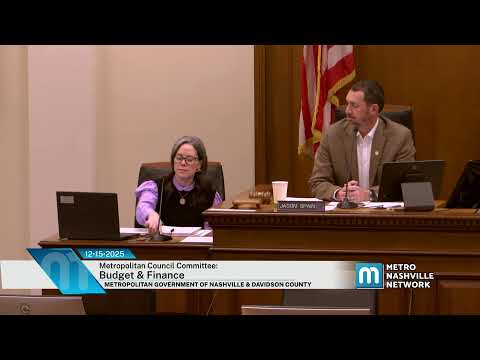
The Budget & Finance Committee on Dec. 15 recommended approval of a memorandum of understanding between Metropolitan Government and the Nashville Downtown Partnership (NDP) related to an FY26 Downtown Public Safety grant, after a sustained public-comment period and amendments that added compliance language and removed specific vendor names from the exhibit.
The committee's action follows public testimony raising procurement and civil‑liberties concerns. Mike Lacey told the committee that a state award to the District Management Corporation (DMC) and routing funds through a private nonprofit could reduce Metro Council oversight; Manning Hall warned of a national pattern in which private nonprofits operate surveillance systems without city oversight. "This is the national playbook now," Manning Hall said during public comment.
Administration staff and counsel described the amendment that binds NDP to follow federal, state and local law and clarifies that law‑enforcement uses would be performed by Metro and therefore subject to Council oversight and future legislation. Director Darby explained the amendment "replaces the agreement with a new attached MOU" and removes named software so future procurements would not be limited to pre‑specified products. Metro legal reiterated that the MOU does not circumvent Metro code requirements for public hearings on surveillance technology.
Councilmembers pressed administration officials about the practical difference between the District Management Corporation (the state grant awardee) and the NDP (the operational organization). Counsel and NDP representatives explained the NDMC is the grant recipient on paper while NDP performs the work and would be the entity bound by the MOU. Ben Simpson, introduced as Chief Operating Officer for the Nashville Downtown Partnership (and employed by the NDMC), said the NDP would perform the work and that changes to grant spending would have to be approved by state partners where applicable.
Councilmember Porterfield asked for an on‑the‑record confirmation that any surveillance equipment purchased or donated would require a public hearing before Council approval; administration and counsel answered that existing public‑hearing provisions in Metro code remain in effect and are not circumvented by this MOU.
Two amendments were added on the committee floor: Amendment 1 (administration-sponsored) updated the MOU language and removed vendor names; Amendment 2 (by Councilmember Coopin) clarified the parties' roles and affirmed that surveillance technology is subject to the relevant Metro code public‑hearing process. Both amendments carried. The item as amended was recommended for approval by committee by voice vote (recorded as 6 in favor, none against, 2 not voting).
The committee record shows the administration committed to council review before Metro accepts any surveillance equipment donations or purchases tied to this grant. The measure now proceeds to the full council for consideration.