Get Full Government Meeting Transcripts, Videos, & Alerts Forever!
Get email alerts on the Education Budget topic
No spam. Unsubscribe anytime.
Norwood presents preliminary FY27 school budget with 2.96% increase, outlines possible reductions if needed
Summary
Superintendent and district finance staff presented a preliminary FY27 level-service budget of $67,222,432 — a 2.96% increase over FY26 — highlighting payroll pressures, a $1.1 million reduction in tuition, MassHealth revenue for three positions, and a menu of potential reductions that would carry operational tradeoffs.
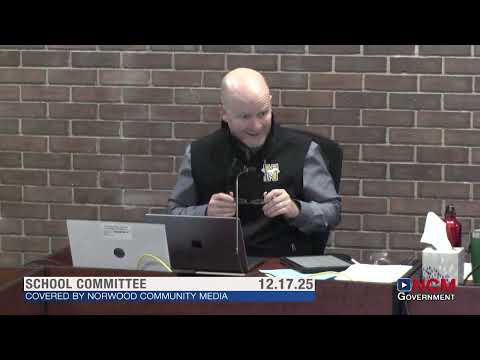
The Town of Norwood School Committee received a detailed preliminary presentation of the school district's FY27 budget on Dec. 17 that shows a proposed level-service budget of $67,222,432, a 2.96% increase over FY26.
Superintendent Dr. Luff said the preliminary plan reflects line-by-line review, contractual obligations and targeted reductions. "I am happy to report that the preliminary budget represents a 2.96% increase over the current FY26 budget," he told the committee. District finance staff described payroll increases (about 5.3% in payroll costs driven by contract step and COLA obligations) offset by projected non-payroll reductions, notably an approximately $1,100,000 reduction in out-of-district tuitions.
Mr. Manion (district finance/operations) presented slides and spreadsheets showing the budget breakdown and assumptions: the $67.2 million figure and a $1,930,315 net increase; estimates of salary and non-salary changes; anticipated circuit-breaker and IDEA grant credits; and an explanation that roughly $300,000 in MassHealth/MassHealth revenue supports three positions. Manion said the district is working with town finance to determine the most appropriate mechanism to receive reimbursement for Medicaid revenue that is currently remitted to the town.
Superintendent Luff and staff also outlined optional reduction scenarios (presented as Tier 1 and Tier 2 options) that could lower the projected increase but would reduce services or change access, including limiting transportation to legally required routes (potentially affecting about 200 elementary students and saving up to roughly $500,000), charging higher fees for athletics (estimated $890,000 in operating costs) and performing arts (approx. $350,000), or reducing elementary interventionists (estimated $800,000 savings) — each carrying significant instructional and equity impacts.
Committee members thanked staff for keeping the increase under 3% while noting the need for continued town coordination and transparency with residents about potential service impacts if larger cuts become necessary. Dr. Luff told the committee the presentation is preliminary and further budget transfers and departmental reviews will follow in January ahead of town meeting timelines.
Next steps: the budget subcommittee will continue work in January, the district will prepare supporting materials for town meeting, and staff will continue discussions with town finance about MassHealth reimbursement mechanisms.