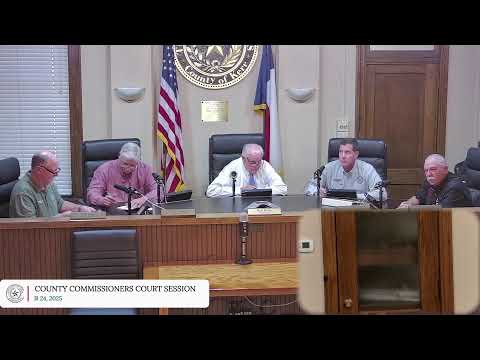
Kerr County debate sharpens on battery energy storage systems, county seeks permitting and fire-safety options
Summary
Commissioners and public speakers debated battery energy storage systems (BESS), focusing on fire-safety, cybersecurity and local permitting. Concerns included company bankruptcies and lease terms; the court said it intends to pursue site-specific protections, possible permitting/fee schedules and consideration of a county fire marshal.
Battery energy storage systems and related planning dominated an extended portion of the Nov. 24 meeting as the Hill Country Energy Subregional Planning Commission and landowners raised safety, legal and policy questions.
Commissioner updates summarized a Nov. 18 regional meeting that highlighted cybersecurity rules, NFPA codes and volunteer fire departments' challenges fighting lithium-ion battery fires. Commissioner comments noted that PUCT/PUC/ ERCOT roles are limited for site-location decisions and stressed the need for site-specific emergency-response plans.
Speakers during public comment, including Audrey Burner and Linda Bullard (landowner representative), cited the bankruptcy filing by Pine Gate/Pinegate (Rio Largo Solar) and expressed concern about long-term leases (transcript cited a 1,154-acre lease and 246-month term) and hazardous-materials and land-use consequences if projects stall. Bullard warned that phrasing a county policy as "safe development" could conflict with prior county positions opposing installations; she urged coordination with the county's 391 planning commission and recommended consideration of a county fire marshal or permitting and fee schedule to ensure site-specific scrutiny.
Commissioners said the earlier resolution and the contracted consulting work were intended to protect the public and that some contract work has already been performed. They emphasized that county options include requiring developers to come to the court for exemptions and creating permit and fee processes to fund inspection and fire-marshal functions. No formal policy change or ordinance was adopted at the meeting; commissioners said further coordination and follow-up briefings are planned.
AI generated
The text on this page is AI generated. Summaries, highlights, analysis, and video transcripts are all produced from the original source material.
AI can make mistakes, so if you spot one, and we will fix it for everyone.
Note: the source content is unaltered by us. Any content source we link to, be it a video, an audio recording, or a document, is presented exactly as its publisher released it. That publisher is usually a government body, sometimes an individual official or another organisation.