Get Full Government Meeting Transcripts, Videos, & Alerts Forever!
Get email alerts on the Health Program Integrity topic
No spam. Unsubscribe anytime.
Senator cites GAO findings of subsidy fraud; witness urges system-design fixes
Summary
At a Joint Economic Committee hearing, an unnamed U.S. senator pressed witness Roy about a recent Government Accountability Office report alleging widespread fraud in health-care subsidies and asked whether Congress should create a health-care 'fraud czar.' Roy said program integrity problems are large and recommended verification and structural reforms rather than only centralized oversight.
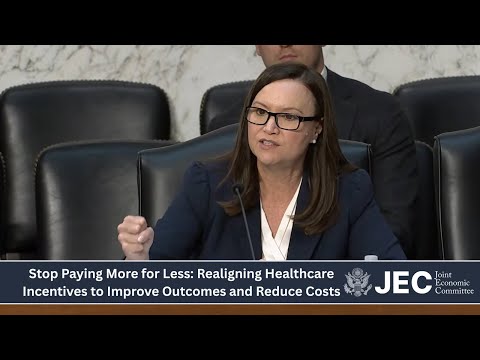
An unnamed United States senator pressed witness Roy at a Joint Economic Committee hearing about what she called a "bombshell" Government Accountability Office report alleging widespread fraud in federal health-care subsidies, asking whether Congress should create a dedicated health-care fraud czar.
"Just last week, the nonpartisan independent government accountability office issued a bombshell report showing all kinds of egregious fraud, like tens of thousands of dead people receiving subsidies, people claiming more than 365 days worth of benefits in a year, government accepting clearly disqualifying information," the senator said, urging stronger oversight.
Roy, a witness called to testify at the hearing, said program integrity is a "huge problem across all of these federal programs." He provided the committee with estimated ranges for improper payments: "The fraud rate in Medicare is about 10 percent. It's estimated to be at least 10 percent, which is a $100,000,000,000 a year. In Medicaid, it's somewhere between 10 to 30 percent," he said, and added that Affordable Care Act subsidy figures "are not well measured" but are likely significant.
Roy identified two primary vulnerabilities in the ACA subsidy system: identity verification and prospective income reporting. He said the GAO report highlighted identity verification concerns, but called income verification "actually a bigger, source of fraud" because applicants currently provide estimated future income on an honor system and receive subsidies prospectively. He recommended designing systems that rely on retrospective income verification and other structural changes to limit opportunities for fraud, rather than treating oversight solely as a matter of naming a single official.
"You can have a czar that has a program integrity czar," Roy said, "and there are program integrity divisions within HHS already. But the real question is how you design the system" to reduce fraud.
The senator said she was troubled that no single official appears solely responsible for rooting out fraud and asked whether legislation should mandate centralized responsibility. Her time expired before follow-up action was taken; she thanked the witnesses and the committee for the testimony.
The exchange focused on the scope of alleged improper payments, the limits of current verification systems for ACA subsidies, and competing ideas about whether responsibility should be centralized or addressed through statutory design changes. The hearing record contains no formal vote or policy decision on the record of this exchange.