Get email alerts on the Health Policy Reform topic
No spam. Unsubscribe anytime.
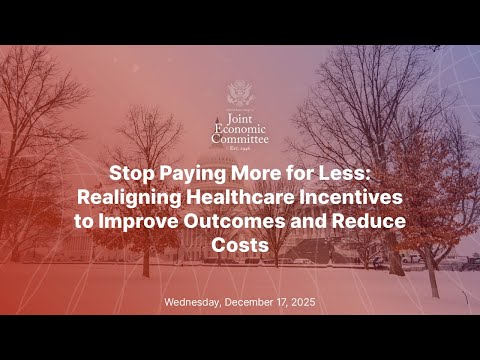
Experts at JEC hearing split on whether competition, public option or structural reforms will rein in U.S. health costs
Summary
Panelists debated competition, public options, antitrust, hospital consolidation, PBM concentration, biosimilar barriers and anti-fraud design; Brookings' Dr. Fiedler emphasized price and utilization levers, FreeOp urged Swiss-style reforms and changes to employer tax treatment, and witnesses suggested statutory fixes for biosimilars and verification.
Dr. Matthew Fiedler of the Brookings Institution told the Joint Economic Committee that lowering private insurance premiums hinges on either paying lower prices for care or using less of it. He recommended actions to boost competition—stronger antitrust scrutiny of mergers and site‑neutral payments—and described a public‑option approach that would set prices administratively (for example, based on Medicare or a multiple of Medicare rates) to lower provider payments in the private market.
Ovik Roy of the Foundation for Research on Equal Opportunity argued the historic tax exclusion for employer‑sponsored insurance is a central driver of high U.S. prices. He urged statutory reforms that would build a functioning individual market and enable longer-term contracts (3–5 years) and employer-funded cash to let workers buy individual plans—elements he said resemble the Swiss system and would incentivize insurers to invest in prevention.
Committee members pressed witnesses about market structure and program integrity. Witnesses said concentration among a few PBMs enables extraction of large payments and recommended greater employer-side contract transparency; they noted statutory barriers to biosimilar competition (Biologics Price Competition and Innovation Act of 2009) and proposed changes to speed biosimilar entry. On fraud, witnesses highlighted GAO findings on identity and income verification in ACA exchanges and offered system-design recommendations—retrospective income verification and improved identity checks—to reduce improper payments.
On hospital consolidation and site neutrality, panelists described how hospitals buying physician practices relabel services as hospital outpatient care to collect higher facility payments, and they recommended site‑neutral payment reforms and targeted competition measures to counteract monopoly pricing. Several members discussed moving federal employees into exchanges (FEHB migration) as a mechanism to enlarge individual markets and finance reinsurance to stabilize premiums.
The session produced no legislative action, but witnesses and members signaled interest in statutory fixes for biosimilar pathways, employer‑tax treatment, verification rules for subsidies, and pilot demonstrations to evaluate public‑option pricing and longer-term enrollment contracts.
AI generated
The text on this page is AI generated. Summaries, highlights, analysis, and video transcripts are all produced from the original source material.
AI can make mistakes, so if you spot one, and we will fix it for everyone.
Note: the source content is unaltered by us. Any content source we link to, be it a video, an audio recording, or a document, is presented exactly as its publisher released it. That publisher is usually a government body, sometimes an individual official or another organisation.