Get Full Government Meeting Transcripts, Videos, & Alerts Forever!
Get email alerts on the Campaign Finance Security topic
No spam. Unsubscribe anytime.
FPPC updates security-expense reporting after AB 789, sets $10,000 annual cap starting 2029
Summary
The commission updated Form 463 to reflect AB 789: selected officers' security expenses will be permitted without limit through 2028 and subject to a $10,000 per-year cap beginning Jan. 1, 2029; commissioners discussed COLA adjustments, merchant restrictions and licensing questions for private security.
The Fair Political Practices Commission voted to approve updates to Form 463, the report of security expenses, to reflect legislation enacted this year (AB 789) that removes a prior lifetime cap and establishes a $10,000 annual cap beginning Jan. 1, 2029.
Senior counsel Chloe Hackert told the commission the statute (AB 789) permits certain security expenses with no limit until Jan. 1, 2029, at which point the law caps those expenses at $10,000 per calendar year. "This reverses the lifetime cap that was in place before," Hackert said, and staff recommended updating the form and instructions to reflect the change and to clarify prohibited expenditures for family members.
Commissioner Wilson asked whether there is a cost-of-living adjustment tied to the $10,000 threshold; Hackert said she was not aware of any COLA provision in the statute: "To my knowledge, there isn't any adjustment with COLA or anything regarding cost of living adjustment," Hackert said.
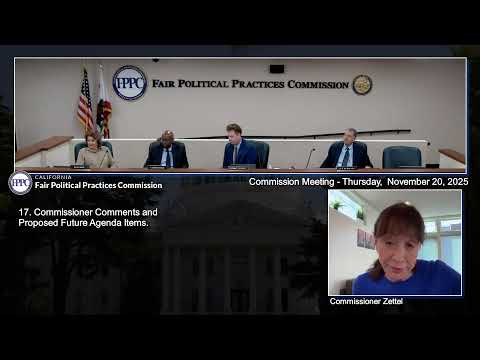
Commissioner Zettel asked whether campaign funds could pay private security guards and whether licensing for private guards should be required; general counsel Dave Bainbridge said the statute lists disqualified paid recipients (spouse, child, parent, grandparents and a set of relatives) and staff would follow up on licensing questions.
The commission approved the Form 463 updates by voice vote. Commissioners asked staff to consider whether licensing or minimum qualifications should be required for private security paid from campaign funds and suggested the topic be discussed at a future legislative or agenda item.
What this means: Campaign committees and elected officials who pay for security must report those expenses on an updated Form 463 under the new statutory regime. The $10,000 cap will apply per person per calendar year after 2028 unless the Legislature amends the law.
Next steps: Staff will finalize the updated Form 463 instructions and consider returning with a future agenda item evaluating whether licensing or other guard-qualification rules should be recommended to the Legislature.