
Board receives construction and facilities updates on Coltrane Webb, Opportunity School, fuel farm and Cox Mill track
Get AI-powered insights, summaries, and transcripts
Sign Up Free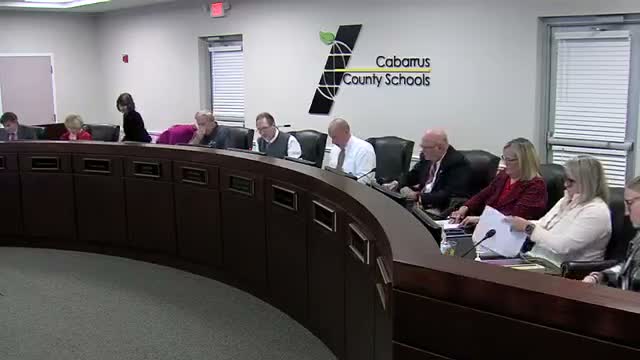
Summary
Construction staff reported progress on Coltrane Webb STEM topping‑out, interior and envelope work at multiple projects, temporary heat and timeline information, progress on a new fueling island with three 20,000‑gallon diesel tanks and updates on Cox Mill High School track pacing and rubberized surfacing.
At the Dec. 1 work session Brian Cohn of the district’s construction team updated the Cabarrus County Board of Education on a portfolio of active projects.
Cohn reported that concrete masonry unit work at Kolter and Coltrane Webb STEM Elementary is largely complete, the brick veneer work for Classroom Wing C began the day of the meeting, storefront frames and glazing are being installed, and hydronic pumps have been set in the boiler room. He described a recent topping‑out ceremony and noted that contractors and the district staged student tours of the site.
For Mary Frances Wall (project update), interior metal stud work, blocking for wall‑mounted devices and rooftop mechanical unit installations are underway; temporary heat was being installed to allow drywall work to proceed. Cohn listed an anticipated May 2026 completion for that project.
The Opportunity School project was described as moving quickly now that it is dried in, with exterior metal siding about 95% complete and a projected April completion.
On the fuel farm, Cohn said canopy work is finished and three 20,000‑gallon diesel tanks (plus a DEF tank) are in place; SPATCO remains the petroleum contractor finishing equipment installs and testing. He said the district is coordinating operator training and expects remaining paving and landscaping to be finished, weather permitting, before the holidays.
Cox Mill High School’s track surface has been paved and the district plans to apply the rubberized system when temperatures are reliably above roughly 55°F; GeoSurface is the vendor for the surfacing.
Board members asked technical questions about integration of new mechanical systems with existing portions of schools, the temporary heating equipment used in winter construction (remote‑tank diesel or propane heaters rather than older torpedo heaters), and whether repurposed rooftop units have been reused at some sites (Cohn confirmed reuse where appropriate).
The district said it will post presentation materials on the district website and the Engage page and continue to coordinate with schools as projects enter the fit‑out and furniture selection phases.