Get Full Government Meeting Transcripts, Videos, & Alerts Forever!
Get email alerts on the Water Resources topic
No spam. Unsubscribe anytime.
Florida to award $112 million in water and springs grants across Gulf Coast and Central Florida
Summary
Governor DeSantis announced more than $112 million in state grants for alternative water supplies, springs restoration and algal-bloom research; projects are expected to yield nearly 94 million gallons per day and cut nitrogen in targeted springs by about 100,000 pounds annually.
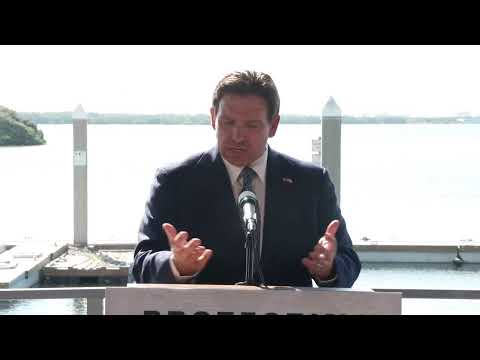
Governor Ron DeSantis announced the state will award over $112,000,000 in grants to improve water quality and expand supplies across Florida's Gulf Coast and Central Florida, saying $50,000,000 of that total will fund 14 alternative water supply projects expected to produce almost 94,000,000 gallons per day when fully operational.
"We're gonna be awarding over a $112,000,000 in grants to improve water quality and supply across Florida's Gulf Coast and throughout Central Florida," DeSantis said. He said a separate $50,000,000 package will fund 23 springs-protection projects and that the new investments will reduce nitrogen in those springs by about 100,000 pounds per year.
Alexis Lambert, secretary of the Florida Department of Environmental Protection, emphasized the administration's science-driven approach to the awards. "A strong economy and a healthy environment are not competing interests," Lambert said, adding that the grants will expand reclaimed-water use, improve aquifer recharge and help communities connect septic systems to central sewer to reduce nutrient pollution.
Dr. Mark Raines, Florida's chief science officer, described the grants as part of a broader push to deploy monitoring and early-warning tools for harmful algal blooms. "Septic to sewer conversions reduces the nutrients that are in our water bodies that fuel the harmful algal blooms," Raines said, noting the state is investing in modeling and response technologies to detect and suppress blooms earlier.
Local recipients also outlined how the awards will be used. Eric DeHaven, executive director of the Polk Regional Water Cooperative, said the DEP funds will support a southeast Lower Floridan aquifer production facility and transmission main. "Under the first phase of this project, we'll provide 7 and a half million gallons per day of water to 10 Polk County cities," DeHaven said, adding later phases could bring capacity up to 30 million gallons per day.
The package also includes $12,000,000 for research and technology grants to state universities and counties to develop detection, prevention and mitigation tools for harmful algal blooms; DeSantis said the state has previously appropriated $75,000,000 and supported 68 projects under the "Innovative Technology for Harmful Algal Blooms" program.
DeSantis framed the awards as part of a sustained, multi-year effort that has included billions in Everglades restoration and infrastructure investments. He said the state has funded roughly 147 springs-restoration projects totaling about $430,000,000 since he took office and that the new grants complement those efforts.
Next steps include project planning and coordination with local water management districts and the Legislature; DeSantis said the administration would continue to work with local partners to implement the grants and that additional awards are expected in coming months.