Delaware County explains $300,000 microenterprise CDBG: who can apply, what’s eligible and key deadlines
Loading...
Summary
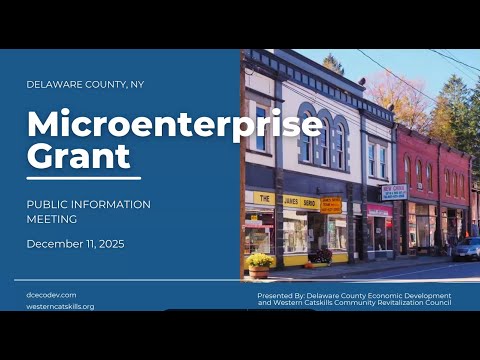
Delaware County staff outlined a $300,000 New York State HCR CDBG microenterprise program that will fund small grants and training for startups and existing businesses that create or retain jobs for low-to-moderate-income (LMI) persons. Applications open Feb. 2; the deadline is May 18, 2026.
Delaware County staff on Jan. 8 described a $300,000 New York State Homes and Community Renewal (HCR) Community Development Block Grant (CDBG) Microenterprise Program that will provide grants and entrepreneurial training to support startups and existing businesses that create or retain jobs for low-to-moderate-income (LMI) individuals.
In opening remarks Speaker 1 said, "Delaware County was awarded a $300,000 New York State Homes and Community Renewal community development block grant for microenterprise program to support businesses, both start up and existing enterprises." The county intends the funding to provide small grants and training to businesses with five or fewer employees, including the owner.
Why it matters: the program is designed to meet CDBG national objectives by either (a) creating new full‑time equivalent jobs for LMI persons or (b) serving businesses owned by LMI individuals. Speaker 2 summarized this test: if more than one job is created, at least 51% of the jobs must go to LMI individuals; alternatively the owner may qualify as LMI based on household income.
Who can apply and key definitions - Eligible microenterprises are businesses situated in Delaware County with five or fewer employees (including the owner). "Micro enterprise is a business with 5 or few employees, including the business owner at the time of application," Speaker 1 said. - A full‑time equivalent (FTE) for the program is 37.5 hours per week, as Speaker 2 clarified. That FTE is the job unit counted toward the program objective. - Startups are eligible if they have been in business six months or less at the relevant measurement date specified in the program guidance.
Funding, matching and reimbursement County staff said individual grant award amounts will be defined in program guidance. Application materials presented to attendees described owner equity and match requirements: a 50% owner contribution is typical, with a minimum 10% provided in cash; the remaining share may be cash, traditional debt financing or other documentable sources. Speaker 2 said, "For businesses that are at least 51% owned by individuals meeting low to moderate income guidelines, the required equity contribution is reduced to 40%; however, a minimum of 10% must still be the cash equity of the owner."
All disbursements under the program will be on a reimbursement basis: recipients must submit invoice and payment documentation to receive grant funds. As Speaker 1 put it, "A reimbursement basis basically means that you have to have all of the project funds upfront." The county advised applicants to secure financing or other sources for required matching contributions before applying.
Eligible and ineligible costs County staff listed eligible expenses as inventory, machinery, furniture, movable fixtures, equipment and operating expenses. Ineligible costs include repayment of existing debt, construction and renovation as direct grant‑funded expenses (though construction may be used as match), assistance to nonprofit entities, costs incurred prior to an award, political or religious activities, and lobbying.
Training and documentation All successful applicants must complete an OCR‑approved entrepreneurial training program offered by the training provider cited in the materials as "WCCRC." Speaker 2 said participants pay a $100 refundable deposit and will receive a certificate of completion required to access funds. Training is planned as a roughly 24‑hour course delivered over four weeks in the evening to accommodate working owners.
The full application will require documentation to verify eligibility and planned outcomes, including federal tax returns (personal and business) for owners claiming LMI status, personal bank statements, business financials where applicable, proof of site control (lease or deed) and evidence supporting the use of funds and match. Speaker 1 emphasized, "Documentation of everything — all the invoices, notes, and emails — those are pretty important."
Timeline and next steps County staff said training registration will open after a second informational meeting on Jan. 8; training is planned mid‑February through mid‑March. The full application will launch Feb. 2 and the application deadline is May 18, 2026. Staff said program monitoring will extend through project completion (a grant term discussed as up to 24 months) and that recipients should demonstrate measurable progress within the first six months.
Questions and points of clarification raised by attendees Attendees asked how LMI status will be verified for employees and owners. County staff said they will rely on documentation such as the New York State 45 form, federal tax returns and other household income information to determine household income against HUD area median income guidelines (the county showed the 80% AMI column during the presentation). Attendees also asked whether Social Security income counts toward household income; staff said taxable portions reported on tax returns are included in income calculations and that the county will clarify specifics in guidance.
What is not decided No formal award allocations to specific businesses were made at the meeting; staff repeatedly said applications will be reviewed and scored case‑by‑case by a review committee and that the program guide will provide additional detail on amounts, allowable documentation and timing.
What comes next Staff will post the recording and presentation to project websites and email registrants. A second public information session and the training registration will precede the Feb. 2 full application launch. The county encouraged prospective applicants to begin assembling documents and to seek financing partners early because the program operates on a reimbursement basis.