Get Full Government Meeting Transcripts, Videos, & Alerts Forever!
Get email alerts on the Utility Rates topic
No spam. Unsubscribe anytime.
St. Helens staff propose phased rate increases to fund new reservoir and sewer upgrades
Summary
City staff and a hired consultant proposed annual increases to water (6.35%), sewer (4.64%) and stormwater (4.79%) over five years to fund a new 5,000,000‑gallon reservoir (budgeted $15M) and a $24.8M sewer capacity project; staff said grants and SRF loans will offset borrowing, while residents raised affordability and collection concerns.
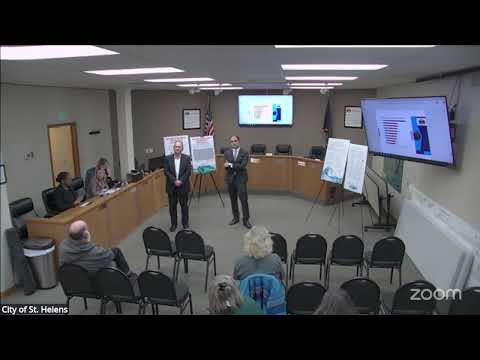
City of St. Helens Public Works staff and an outside consultant recommended a phased rate plan on the evening’s open house to finance major water and sewer capital projects and ongoing operations.
Mohammed Zaire, the city’s public works director, introduced consultant Steve Donovan, who said the city needs a new 5,000,000‑gallon reservoir to replace aging storage off Pittsburgh Road and Battle Mountain that has been out of service. Donovan estimated the reservoir at about $15 million and said a siting study by Keller Associates has narrowed eight candidate locations; staff expect all work on the reservoir to be completed by around 2030.
Donovan also described a sewer capacity program focused on basins 4 and 6, with design about 90% complete and an estimated construction cost of roughly $24.8 million. He said design was funded by a $2.5 million grant from Business Oregon and that construction financing is expected through the Clean Water State Revolving Fund (SRF), which includes an anticipated $2 million principal‑forgiveness component.
To pay for the projects and to maintain operations, Donovan proposed annual rate increases for five years: water 6.35% per year, wastewater 4.64% per year and stormwater 4.79% per year. He said the average customer now pays about $143.10 per month for water, sewer and stormwater combined and estimated the bill would rise to approximately $150.82 on July 1 under his recommendation and reach about $186 by 2031 if the full five‑year plan is adopted. Donovan described the increases as part of a strategy that uses SDCs (system development charges), cash reserves and borrowing amortized over project useful lives to limit sudden large jumps in rates.
Donovan and staff explained the city currently carries existing water debt service of about $463,000 per year (scheduled to retire in 2029) and a sewer share of roughly $565,000. Their plan anticipates retiring some existing debt and taking on new debt tied to the projects, with repayment schedules aligned so debt service does not spike unexpectedly. Donovan said the city has about $3.6 million in the water operating fund and $1.1 million in water SDCs available to help buy down borrowing.
Staff described the stormwater utility as the smallest of the three (currently $17/month) and said there is no debt service attached to it; planned stormwater work includes CCTV inspections and a small annual capital program.
Funding and process: Donovan told attendees the sewer design was grant‑funded and that a Clean Water SRF loan with principal forgiveness is expected for construction. He said staff will present draft siting study findings to city council in a work session this winter, the budget cycle begins in spring, and the final rate resolution would come with the budget for council adoption (target implementation date discussed as July 1 if adopted).
Public reaction: Several residents pressed staff on affordability, whether developers and large new apartment complexes pay enough via SDCs, and whether state‑funded housing (described by staff as sometimes tax‑exempt by state mandate) shifts costs to local ratepayers. Residents also raised memories of a prior council discussion about a $42 “general services” charge that some residents believed would be added to utility bills; staff said that particular fee proposal did not pass and clarified that liens are one of several collection tools used for unpaid municipal charges, not a policy to cut water service for basic nonpayment.
What’s next: Staff invited written questions and comment cards and said Donovan’s recommendation will be looped back to the council at a work session, then enter the budget process in the spring with a final rate resolution to be adopted by the council before any July 1 implementation.
Quote: "We're going to have to take on debt, amortize that debt over time to manage the rates," Donovan said, later summarizing the recommendation: "water 6.35% per year, wastewater 4.64% and stormwater 4.79% for the next five years."