Get Full Government Meeting Transcripts, Videos, & Alerts Forever!
Get email alerts on the Infrastructure Replacement topic
No spam. Unsubscribe anytime.
City budgets modest replacement work as older cast-iron mains continue to fracture
Summary
Staff told the study session that most main breaks occur in 6–8 inch cast-iron pipes from the 1940s–1960s; the city has budgeted $300,000 for main replacement in 2025–26 and plans a ~$400,000 Walnut Street project as part of a long-term replacement program.
Ellensburg public works staff told a Dec. 1 study session that aging cast‑iron mains remain the primary source of water main failures and outlined near‑term funding and replacement priorities.
Ryan Liske, the city’s public works director, reviewed break statistics and pipe inventories and said most failures occur in older 6‑ and 8‑inch cast iron installed in the 1940s, 1950s and 1960s. He explained how several common failure modes—spiral and ring cracks—occur where pipe bedding is poor or where rocks induce point loading, and that the city’s current repair practice is to cut out damaged segments and install ductile iron replacements or mechanical couplers.
Liske said the 2025–26 budget includes $300,000 targeted to start replacing cast‑iron mains and that staff are proposing a roughly $400,000 project to replace about 600 feet on Walnut Street (5th Avenue to University Way) next year. He noted that, based on mapping, roughly 25,000 feet of 1950s‑era pipe remain and that replacing mains at an assumed rate of about 400 feet per year would stretch the program over decades.
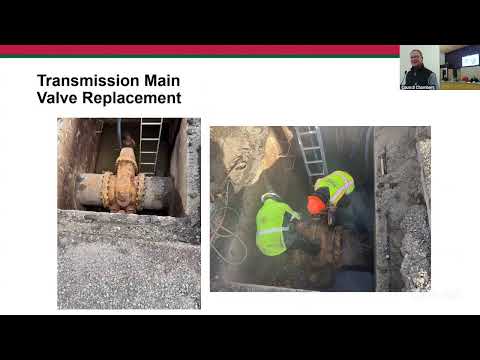
Staff described steps to reduce future failure risk: enforcement of current bedding standards (pea gravel bedding), use of ductile iron for new pipe, continued leak detection to identify failing segments early, and staged capital budgeting to address high‑break locations first. The transmission main work was highlighted as particularly complex; crews recently replaced five of six large isolation valves on the 6‑mile transmission main that feeds the city, and one valve remains for spring replacement.
Liske and other staff emphasized that the replacement program is a multi‑year effort, with funding and scheduling to be considered in upcoming biennial budgets.