Get Full Government Meeting Transcripts, Videos, & Alerts Forever!
Get email alerts on the Housing Element topic
No spam. Unsubscribe anytime.
Sedro‑Woolley council reviews housing-element options, questions feasibility of 0–30% AMI targets
Summary
City staff presented Planning Commission recommendations and results from a public housing forum and survey; council members praised "gentle density" ideas but repeatedly said state targets for lowest‑income housing (0–30% AMI) appear unrealistic without subsidies and raised concerns about costs and local services.
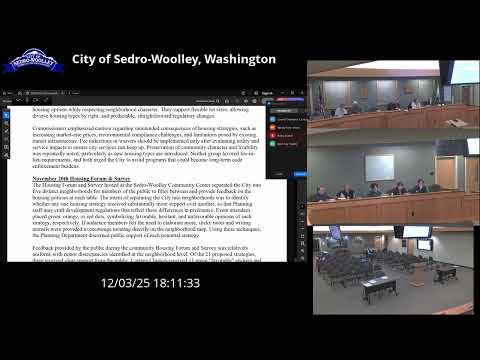
Sedro‑Woolley — City staff presented draft policies for Chapter 3 of the comprehensive plan, the housing element, and summarized planning‑commission and public‑forum feedback as the council prepared to send the draft to the Washington Department of Commerce for a 60‑day review.
Nicole, summarizing the Planning Commission, said commissioners favored “gentle density” approaches — small‑scale options such as cottage clusters, townhomes and other middle‑housing types — and recommended preserving existing homes while making modest permitting changes to encourage reinvestment. Ashton, reporting on a pre‑Thanksgiving housing forum and follow‑up survey, said the public supported cottage clusters and allowing duplexes on single‑family lots in parts of the city, and identified preapproved accessory‑dwelling unit (ADU) plans as a way to reduce design costs for homeowners.
The council welcomed many of the proposals but raised repeated reservations about the state’s low‑income target. Councilman LaVaca questioned whether the measures would reach the 0–30% area median income (AMI) band and described the state’s numeric expectations as “unheard of,” saying the city would likely need subsidies to meet those levels and warning of added demands on schools, police and fire services. Tom (staff) said the comp plan contains policy language and that specific regulatory changes would come later in the development‑regulation update.
Several council members also discussed potential tradeoffs. Councilwoman Diamond recalled the city auditor’s earlier statement that the multifamily tax‑exemption (MFTE) “was actually not beneficial to the community as a whole,” and cautioned that adding climate requirements could increase building costs that are passed to renters and buyers. Councilman Clark and others noted that unit‑lot subdivisions and smaller lot sizes can create smaller, lower‑cost housing that could help homeownership opportunities.
On process and timing, staff described the next steps: the Planning Commission will hold a public hearing on December 16, the city will submit the draft to the Department of Commerce for the statutorily required 60‑day review (staff said they will seek expedited review), and the council could hold a first reading of the ordinance adopting the plan on January 14. Staff also said state‑mandated ADU rule changes will be implemented through the development regulations update and that the city expects to begin approving permits under the state’s ADU rules by the first of the year.
The meeting closed with a reminder that the comp plan is a policy document meant to guide later regulatory work; council members asked staff to continue outreach, provide fuller notes from earlier meetings, and consider which elements of the draft might be refined before formal submission to state review.