South Berwick hears detailed briefing on LD 1829 and potential growth-area changes
Loading...
Summary
Planner Matt DeCarlo told the Town Council how Maines LD 1829 (effective July 2026) will change local land-use controls, including ADU rules, density calculations (potentially up to 32 units per acre in serviced growth areas), and limits on moratoria. Councilors asked for workshops and urged outreach to water and sewer districts.
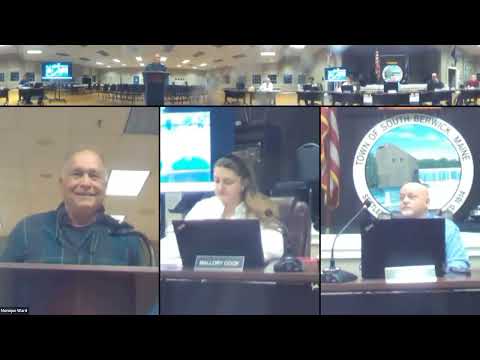
Matt DeCarlo, a planner presenting remotely, briefed the South Berwick Town Council on LD 1829 and focused on how the laws growth-area provisions will affect the town when the statute takes effect in July 2026. "A growth area is where you want to direct the majority of new development," DeCarlo said, and noted that the bill alters many local land-use levers the town has traditionally used.
DeCarlo explained key changes: accessory dwelling units (ADUs) no longer require owner occupancy or sprinklers in standalone ADUs, planning-board review is limited for small multifamily structures, and setback rules now apply uniformly regardless of dwelling count. He walked the council through a numerical formula in the law used to determine maximum units per area: in growth areas with shared water and sewer capacity, subdivision rules can lead to as many as 32 units per acre over time after five-year subdivision resets. "I'm looking at how you can get to 32 units per acre," he said, describing how subdivision and lot-split rules compound over several rounds of development.
Councilors and attendees asked how water and sewer capacity will be counted. DeCarlo said the statutes language treats any shared water or wastewater system (not only municipal systems) as qualifying for the density bonuses, and he said he was seeking clarifications from the attorney general and legislators on that point. "It specifically refers to shared water systems and shared wastewater systems," he said, acknowledging that private shared systems could enable higher density.
Members raised timelines and implementation questions. Several councilors said the town has limited time before the law takes effect and suggested seeking a legislative extension or a cleanup measure. DeCarlo recommended a series of deeper workshops, additional planning-board work (including synoptic surveys to document existing building patterns), and at least one community meeting to explain trade-offs and options. He also flagged an expected grant round (MoCA) that would offer roughly $15,000 to support towns adopting LD 1829 provisions.
Councilors emphasized practical concerns beyond density math: potential effects on water and sewer capacity, municipal service needs including fire and public safety, school impacts, and whether increasing supply alone will produce affordable or workforce housing. One councilor said, "There's nothing in here that addresses workforce housing," urging the town to consider complementary policy tools.
DeCarlo closed by urging the council and planning board to identify specific workshop topics and to prepare land-use amendments and comprehensive-plan updates, noting that growth-area designations in the towns comprehensive plan determine where state-mandated provisions will apply. The council instructed staff to continue planning follow-up workshops and to coordinate with the planning board and regional partners.