
Madison Local board approves deficit-reduction plan after state flags multi-year shortfalls
Get AI-powered insights, summaries, and transcripts
Subscribe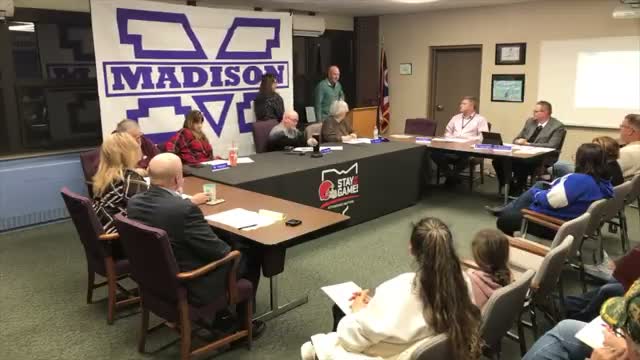
Summary
The Madison Local Board of Education approved a written deficit-reduction plan after the Ohio Department of Education and Workforce found projected deficits in three forecast years; the state gave a Dec. 21 deadline to submit a board-approved plan to avoid fiscal oversight.
Madison — The Madison Local Board of Education unanimously approved a written deficit-reduction plan on Nov. 18 after state fiscal consultants told the board the district’s October financial forecast projects deficits in the current year and the first two forecast years.
Christopher Wright, a fiscal consultant with the Ohio Department of Education and Workforce, and Kim Richard, assistant administrator in the department’s budget and school funding office, told the board the forecast filed Oct. 13 showed negative balances and that the district received a notification letter on Oct. 22 requiring a written plan. "As you can see, they're red and they're negative, so those are projected deficits," Wright said during the presentation. Richard added the district was "one of the two in the entire state" flagged for a current-year deficit in that submission period.
The department explained the written plan must be approved by the local board and submitted to the department by Dec. 21, 2025, unless the district requests and is granted an extension. The plan must rely on actions within the district's control — such as expenditure reductions, hiring freezes, retirement incentives and other plan items that can be documented in the required workbook and narrative — rather than on uncertain revenue sources. The state will review the submission and ask the district to update its February forecast to reflect adopted plan items.
Board members and the administration identified several causes for the sudden change between the earlier forecast and the October filing. A board member said the Lake County commissioners doubled the homestead exemption and the owner-occupancy tax credit, reducing district revenue by roughly $400,000 annually. The board also reported a consortium health-insurance assessment of about $430,000; together, those assessments accounted for approximately $800,000 of unanticipated need, according to the board’s summary of the impacts.
At the meeting the treasurer reported operating-year-to-date figures through October: general fund revenues of $11,595,582 and expenditures of $11,450,125, with a total fund balance of $2,013,415. Board members voted earlier in the evening to adopt the financial statements and then discussed the state presentation before moving to approve the deficit-reduction plan.
Board members emphasized the plan approved Nov. 18 focuses on eliminating the current-year deficit to avoid fiscal caution and further oversight, and they said the district will aim to implement reductions with minimal impact on staff and students. The state team advised that eliminating deficit spending (line 6.010) and implementing plan items promptly produces compounded improvement across the forecast window.
The board also discussed whether an incoming board after the recent election could modify an approved plan. State representatives said plans can be amended later if the amendments preserve solvency and are documented and reapproved by the board and the department.
Other routine business: the board accepted a long list of donations to schools (including monetary gifts ranging from $60 gift cards to $500 donations and in-kind items such as 480 donut rolls from Dunkin' Donuts), approved a memorandum of understanding with OPC regarding an annual unit-rate adjustment, approved multiple personnel recommendations (resignations, supplemental and substitute contracts, and transfers), and adopted a consent calendar that included agreements with Crossroads Health and other administrative items. These motions were carried by roll call votes recorded as unanimous (motion carries 4-0). The meeting concluded with a notice of a need for executive session and adjournment.
What happens next: The board-approved written plan will be submitted to the Ohio Department of Education and Workforce for review; the department said it will expect the district to reflect plan items in the February forecast update and will monitor implementation via monthly reporting if the district reaches a higher level of oversight. If the district does not submit an acceptable plan by the required date and an extension is not granted, the department could recommend fiscal caution and further oversight steps.