Get Full Government Meeting Transcripts, Videos, & Alerts Forever!
Get email alerts on the Personnel topic
No spam. Unsubscribe anytime.
Council hears compensation plan to boost pay for utility workers and dispatchers; changes to take effect Jan. 1
Summary
Staff and the compensation subcommittee recommended reclassifying utility maintenance workers as 'utility systems technicians' with higher starting pay, and raising dispatcher starting pay with a step and certification structure; utility adjustments were included in the FY26 budget and dispatcher changes will be addressed via a January budget amendment.
The city’s compensation subcommittee presented recommendations to address recruitment and retention in two critical operational areas: the utilities division and dispatch.
Staff proposed changing the utility job title from "utility maintenance worker" to "utility systems technician," increasing the starting pay (presented as a move from roughly $34.8 to $38.00) and adjusting pay for equipment operators and crew leaders to avoid internal compression. Mr. Garza said the change is intended to better reflect required skills, on‑call expectations and overtime realities; staff included roughly $200,000 in the FY26 budget to fund the utilities pay enhancements.
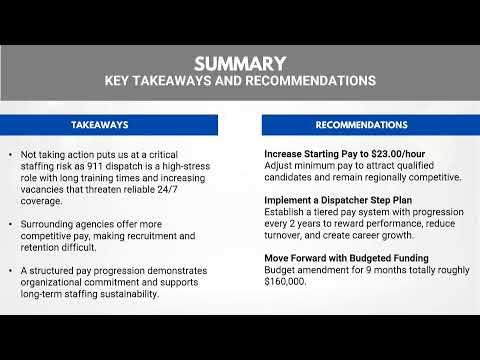
For dispatch, staff urged increasing the starting hourly rate from about $19.60 to $23 to match competition (the county sheriff’s office was cited as offering higher starting pay) and creating a multi‑level step structure tied to certifications that mirror police and fire progression. Staff also proposed a sign‑on bonus to recruit experienced dispatchers and said a budget amendment of about $160,000 will be brought forward in January to make the dispatcher changes effective Jan. 1.
Council members on the subcommittee said the analyses showed not just pay gaps but also turnover driven by the work schedule and on‑call demands; they supported the proposals as a way to attract a more reliable workforce for critical water and emergency‑response systems. Council indicated support for the recommended changes and commended the subcommittee for its analysis.