Get Full Government Meeting Transcripts, Videos, & Alerts Forever!
Get email alerts on the Infrastructure Stormwater topic
No spam. Unsubscribe anytime.
Corte Madera installs three inline Tideflex check valves to curb tidal flooding
Summary
Town staff installed three inline Tideflex valves at Lucky Drive, Golden Hind Passage and Channel Drive to replace failing flapper and duckbill gates; officials say valves reduce tidal inflow but won’t prevent flooding when high tides coincide with heavy rain, and ongoing corrosion and disposal costs pose fiscal challenges.
Public works staff reported the town installed three new Tideflex inline check valves at priority locations to replace failed flapper and duckbill gates, a move officials called necessary to keep tidal water out of the storm system during king tides.
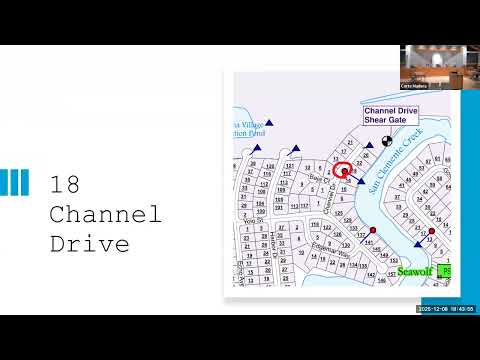
Town public-works staff (unnamed) told the Flood Board that the first valve replaced a corroded flapper gate near Lucky Drive, across from High Canal and adjacent to the boathouse; in another case, a duckbill at 131 Golden Hind Passage in Mariner Cove had fallen off and staff installed the Tideflex upstream of the corroded corrugated-metal outlet. At 18 Channel Drive staff replaced a leaking box-style check valve that had repeatedly failed; that installation protects Baja Court, which sits at a very low elevation.
“we ordered 3 new, of the Tideflex inline check valves that you put, like, inside the pipe” (Speaker 2), staff said, adding that the devices expand inside the pipe and create an internal barrier.
Staff cautioned that inline check valves slow tidal intrusion but do not eliminate flooding when the creek or system elevation is higher than adjacent streets or when storms combine heavy rain with high tides. “If it's a high tide and it's raining, the check valve can't really do anything in that situation,” staff said (Speaker 2).
Board members pressed on maintenance and corrosion. Staff said many outfalls are corrugated metal and are corroding; some installations were moved upstream to manholes because working in the channel has become more difficult. The town said check valves typically cost in the mid‑thousands each (staff estimated a range of about $10,000–$15,000 per unit) and that many replacements have been handled in-house.
Board members identified additional candidate locations for future purchases and maintenance — including sites at 167 and 223 (where one site lacked a valve and another likely had debris lodged in a newer valve), Key Largo, and areas along Paradise Drive and Robin Drive where sediment fouling has repeatedly jammed flapper gates. Staff said they will budget and prioritize replacements and continue to monitor performance.
The board recorded no formal vote on the installations at the meeting; members agreed to continue tracking valve performance and include replacements in future work plans.