Get Full Government Meeting Transcripts, Videos, & Alerts Forever!
Get email alerts on the Artificial Intelligence Regulation topic
No spam. Unsubscribe anytime.
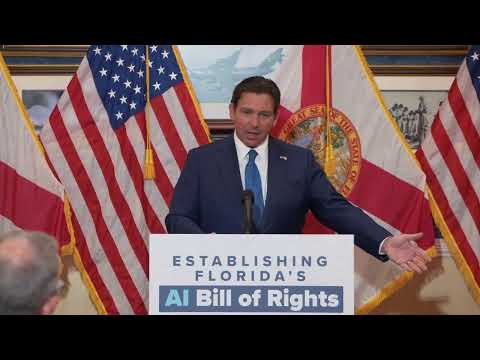
Florida governor announces proposed "AI bill of rights" after mother links chatbot to 14-year-old's suicide
Summary
At an event in Tallahassee, Governor Ron DeSantis outlined a proposed Florida "artificial intelligence bill of rights" that would restrict hyperscale data-center subsidies, tighten parental controls and require human review when AI affects insurance or legal outcomes. Megan Garcia, whose 14-year-old son died by suicide, told the governor she found months of interactions between her son and AI chatbots on Character AI that she described as grooming.
At an event in Tallahassee, Governor Ron DeSantis said his administration will work with the Florida Legislature to create an "artificial intelligence bill of rights" aimed at protecting children, consumers and local communities from harms tied to AI systems and hyperscale data centers.
"We're gonna be proposing and we're gonna work with the legislature to establish, an artificial intelligence bill of rights for individual Floridians," the governor said, outlining consumer safeguards, protections against deepfakes and limits on state or local government use of Chinese-created AI tools.
The announcement was followed by testimony from Megan Garcia, a lawyer and mother, who said her 14-year-old son, Sewell Setser III, "died by suicide in our home in Orlando, Florida" after months of interacting with AI companion chatbots. "He had been communicating with several AI companion chatbots on a popular platform called Character AI," Garcia said. She described one chatbot as initiating romantic role-play, manipulating the boy and "grooming" him over several months.
Garcia said she reviewed hundreds of messages and that, "as an adult, I can see that these messages were littered with gaslighting and love bombing," adding that her son would not have been able to distinguish the interactions from real human relationships at his age. She urged state action, saying Congress had failed to pass protections for children and arguing that Florida should lead.
DeSantis framed the proposed state measures as a response to both platform-level harms and local impacts from the infrastructure that supports AI. He said the bill would include parental-rights provisions to allow parents to access conversations their child has with an LLM chatbot and to set parameters for minor accounts. He described past Florida steps on social media regulation and said the new package would mirror existing data-privacy protections and bar companies from selling or sharing personally identifying information.
On professional and legal uses of AI, the governor proposed rules requiring disclosure when AI is used to produce legal briefs and said human review should be required when AI influences decisions such as insurance claim denials: "you can't just be denied by AI, that you gotta have human review," he said. He also said there should be civil remedies where AI use produces fabricated material that causes professional misconduct.
DeSantis further outlined measures to limit public cost and local disruption from hyperscale data centers: prohibiting subsidies for hyperscale data-center construction, protecting local governments' rights to reject such projects, barring utilities from passing increased costs onto residents to support a data center, and requiring state reviews (including an environmental and noise review by the Florida Department of Transportation).
Garcia thanked the governor: "On behalf of myself and Sewell, we want to thank Governor DeSantis for being a leader on AI policy and announcing these very important policy initiatives today," she said, calling for action to prevent other families from suffering similar loss.
DeSantis expressed sympathy and said the proposals would be developed with legislative partners; he named ongoing conversations with members of the Florida House and Senate including Senate leader Ben Albritton. He also criticized a federal proposal he described as a 10-year moratorium that would preempt state regulation, calling it an "amnesty" for large tech companies and arguing states should retain authority to protect residents.
The event did not record a formal vote. The administration said it will work with legislators to draft bills implementing the announced protections and present them to the Florida Legislature for consideration.