
Apple Valley council bans dedicated cryptocurrency kiosks, waives second reading
Get AI-powered insights, summaries, and transcripts
Subscribe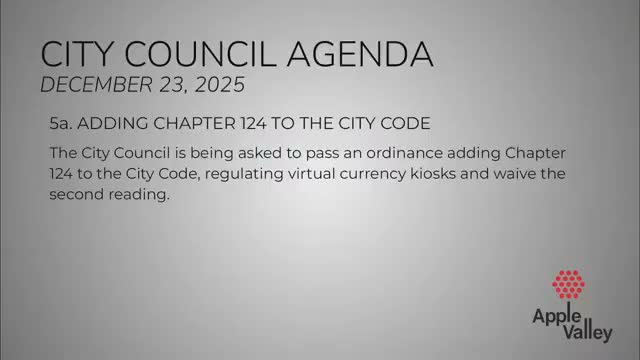
Summary
The council approved an ordinance adding 'Chapter 1 24' to the city code to prohibit dedicated virtual-currency kiosks, citing fraud against elderly residents and local losses; vendors have a March 31 compliance window for dedicated machines and multi-purpose ATMs may disable crypto features instead of removal.
Apple Valley — The City Council on Dec. 23 approved an ordinance adding Chapter 1 24 to the city code to prohibit dedicated virtual-currency kiosks within city limits and waived the ordinance’s second reading.
Chief Francis, introducing the proposal, told the council the police department has identified a trend of fraud tied to cryptocurrency kiosks and urged the ban "to protect our residents, to prevent crime, promote safety and welfare of all the residents and general public." Francis said nationally there were "more than 10,000" complaints in 2024 and that victims reported about $246,000,000 lost; he said Apple Valley residents have lost "approximately a half $1,000,000" over 2024–25, with more than half of those losses involving kiosks.
The ordinance as presented makes it unlawful "for any person or legal entity to operate, place, permit, host, allow, or allow to be placed a virtual currency kiosk at any location within the city." Francis described two machine types in town: some dedicated cryptocurrency ATMs and some multi-function machines that include a crypto feature.
Council members questioned enforcement and penalties. Francis said violations would be a misdemeanor under the new city ordinance and that the city attorney’s office could pursue seizure or other enforcement options if machines remained in place. Council members also discussed using business-license reviews as an enforcement lever for locations that host the machines.
The council discussed compliance timelines. Staff told the council vendors would have until March 31 to remove dedicated cryptocurrency-only ATMs; multi-purpose ATMs would be allowed to remain if operators disabled the crypto feature. Francis said six kiosks were registered with the Minnesota Department of Commerce in Apple Valley and staff planned outreach visits to affected businesses to explain compliance steps.
Council Member Melander moved to adopt the ordinance and waive the second reading; Council Member Bergman seconded the motion. The mayor called for the vote and the council approved the ordinance. No council member voiced opposition during the vote.
The ordinance joins actions by other Minnesota cities mentioned by Francis; he cited St. Paul and Stillwater as municipalities that have acted or considered similar restrictions. The council’s approval sends the city code change into effect under the city’s adopted process; staff said they would coordinate subsequent compliance and enforcement work with the city clerk and city attorney.
The council did not attach a local ordinance number in the meeting record and staff did not provide a prepared fiscal analysis during the presentation. The city said it would notify businesses and provide time for compliance.