
Littleton staff outline Safer Streets prioritization, pilot expansion and new public dashboard
Get AI-powered insights, summaries, and transcripts
Subscribe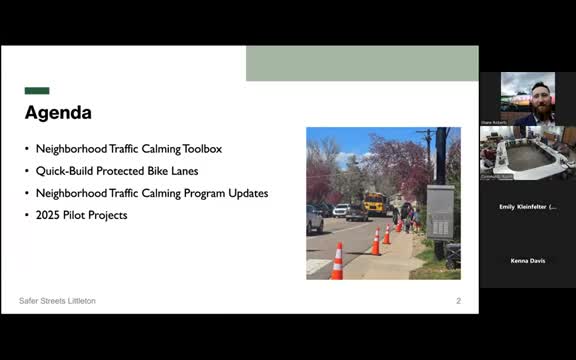
Summary
City transportation staff presented a revised neighborhood traffic-calming program with a data-driven prioritization tool, plans to expand quick-build pilots in spring and a public dashboard expected in early January to show requests, status and before/after data.
City staff on Tuesday briefed the Transportation & Mobility Board on an updated Safer Streets program that formalizes how neighborhood traffic-calming requests will be evaluated, prioritized and moved from temporary pilots to permanent installations.
The presentation described a new scoring tool that weighs speed and traffic volume most heavily, with additional points for mode-priority streets, crash history and nearby activity generators such as schools and parks. Staff described the weights as follows: speed and volume ~20%, priority-mode designation ~20%, crash history 15%, activity generators 15%, repeat requests and street type about 5% each. Staff said the ranking will produce immediate, high, medium and low priority lists used to select an annual package of pilot projects.
Staff explained the pilot-to-permanence workflow: pre-installation baseline counts, installation of quick-build materials (plastic delineators, modular medians, Zikla "zebra" and "zipper" products, rubber speed cushions), three-month post-installation counts and additional evaluation before pursuing more costly permanent construction. The presenter said projects that meet stated safety goals may be advanced for permanent design when funding and crew capacity allow.
The board heard that the city will expand several quick-build and protected-bike-lane pilots in spring, citing specific corridors including a Pennsylvania-Phillips connector and new work on Irving between Bellevue and Berry. Staff emphasized that many pilot materials now in use are substantially more durable than earlier prototypes and that some visual concerns from neighbors are being addressed through design tweaks.
To improve transparency and resident feedback, staff previewed a public dashboard and updated web pages that will show the location and status of every request, priority scores, and before-and-after data when projects are evaluated. The presenter said automated emails and yard signs linking to surveys will arrive with installations to close the feedback loop. Staff told the board the website is targeted to go live in early January.
Board members pressed staff on evaluation and communications. Several members asked whether earlier pilots had been revised; staff provided a short list of seven sites planned for spring revisions (including adding rubber speed cushions where horizontal changes alone did not sustain speed reductions). Staff also warned that moving pilots to permanence can raise costs from tens of thousands for temporary materials to hundreds of thousands or millions for thermoplastic paint, concrete curbs and drainage work, so a separate prioritization step and funding decision will be required.
The board did not take formal action. Staff said the program will come back to the board with the spring installation package, post-installation data and recommended candidates for permanent upgrades.