
Reno approves drone-as-first-responder pilot; police chief highlights safety, medical uses
Get AI-powered insights, summaries, and transcripts
Subscribe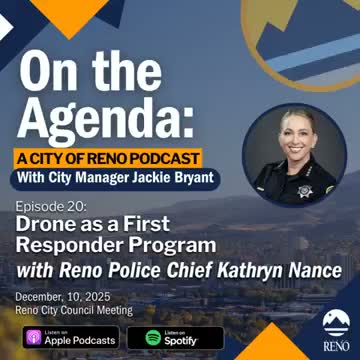
Summary
The City of Reno approved a contract for a drone-as-first-responder pilot with Motorola Solutions and Bridal Technologies. Police Chief Catherine Entz said the pilot — four sites to start — aims to improve officer safety, speed situational awareness and deliver emergency medical supplies.
Reno city leaders have approved a contract enabling a pilot "drone as a first responder" program for the Reno Police Department, and Police Chief Catherine Entz told the city podcast the technology is intended to give officers faster situational awareness and improve public safety.
Chief Entz said the city is partnering with Motorola Solutions and Bridal Technologies as the drone provider. "Drone as a first responder is ... an opportunity for when certain types of calls for service occur, we are able to self‑deploy the drone, and it will fly to the area where the problem is happening and get first‑hand look of what is going on there and relay that information back to our officers," she said.
Entz emphasized officer safety as a primary benefit, saying the drones can provide "eyes on a scene" within about 70 to 90 seconds for incidents within roughly a two‑mile radius, giving responding officers information about whether people on scene are armed or combative before officers arrive. She also described technical capabilities including up to 40× optical zoom, night‑vision modes and thermal sensors to locate heat sources such as missing persons.
The department told the podcast the flights are recorded from takeoff until the drone docks and recharges; recordings are retained when they capture a crime or evidence, and deleted when a flight captures no incident, according to Entz. She said the drones also support non‑law enforcement uses: in coordination with medical response teams and fire, a drone could carry and drop an AED, EpiPen or naloxone to a person in need.
The contract is structured as a one‑year pilot that begins when the first drone responds from an assigned site. The city will start with four sites and may reduce that number (to three or two) at no cost during the first year, Entz said. She described the longer contract (years two through six) as including services, insurance, maintenance and upgrades at an approximate cost of $100,000 per site.
Entz said agencies that have deployed similar systems "have seen about a 25% reduction in calls that officers have to respond to" and a decrease in use‑of‑force incidents, which she argued can yield operational savings and safety benefits.
City staff said vendor site surveys are underway and the department hopes to have drones operational by April, pending required Federal Aviation Administration approvals and other clearances.
Entz also told the podcast the department received a donation from Wyze Labs of 250 security cameras, an in‑kind contribution the department values at more than $7,000, to be distributed via victim services to domestic‑violence survivors at no charge to taxpayers. She said the donation was brought to council for approval before distribution.
The council action recorded in the podcast summary approved the contract; the podcast did not include a formal vote tally or motion text for public record. City officials said they plan to report back to council with a formal update 6–9 months after launch to assess performance, calls cleared, costs and any operational changes.
Next steps: site surveys, FAA clearances and a first deployment that will start the one‑year pilot phase.