Get Full Government Meeting Transcripts, Videos, & Alerts Forever!
Get email alerts on the Homelessness topic
No spam. Unsubscribe anytime.
Heading Home urges coordinated crisis response as Monroe County braces for funding uncertainty
Summary
Heading Home told the County Council the region lacks affordable housing, landlord acceptance of vouchers and sufficient supportive services; a Lilly Endowment grant will fund outreach hires, a data dashboard and a basic-income pilot, but the group warned federal funding uncertainty could worsen homelessness.
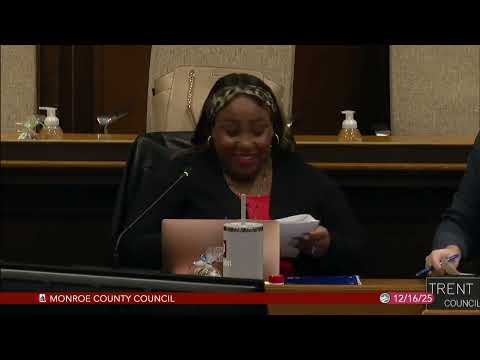
Mary Morgan, executive director of Heading Home of South Central Indiana, told the Monroe County Council on Dec. 16 that homelessness in the region is fundamentally a housing problem and that the community lacks both affordable units and supportive services to keep people housed. “Homelessness is a housing problem,” Morgan said during a slide presentation to the council.
Heading Home outlined a regional approach (Region 10), partnerships with United Way and the Community Foundation of Bloomington and Monroe County, and investments in data and staff. The nonprofit recently launched a dashboard pulling information from the regional homeless management information system to track inflows and outflows of people experiencing homelessness; Tatiana Wheeler, associate director, said the dashboard is updated monthly.
The group described a range of work in Monroe County: a focused housing action plan with targeted recommendations; landlord engagement efforts that identified about 150 vacant units among partner landlords; cross-agency training with the National Alliance to End Homelessness; and a data-driven coordinated-entry system to direct scarce housing resources. Mary Hamrick, Heading Home’s strategic partnerships director, cautioned that vacant units do not automatically translate to housing placements because landlord screening criteria and income requirements often bar prospective tenants.
Heading Home credited a significant Lilly Endowment grant awarded to the Community Foundation for enabling hires and program expansion. The funding will pay for expanded street outreach (six street outreach case managers planned), diversion and prevention case managers, and a guaranteed basic-income pilot administered by SCAP if the pilot proves feasible.
Council members asked how the organization and the county could align responses to encampments so outreach is not disrupted by sudden clearances; Morgan urged convening all key players to agree on crisis protocols and decision trees. Morgan also warned that a recent federal pause and potential pivot in HUD funding policy has created “chaos, uncertainty, fear” among local providers and could increase homelessness if supports are reduced.
The presentation prompted discussion about data interpretation and the need for updated assessments: Heading Home staff said numbers dipping on the dashboard sometimes reflected people moved to an ‘inactive’ status and stressed the importance of frequent reassessments and increased outreach to avoid losing contact with unsheltered people. The council and Heading Home agreed on the need for continued coordination and invited the nonprofit to provide follow-up briefings and training opportunities for frontline staff.
Heading Home said it will share its Monroe County housing action plan and follow up with councilors on opportunities for training participation and joint planning.
The council did not vote on any specific funding at the meeting; members signaled interest in continued collaboration and asked staff to help schedule follow-ups with county departments and regional partners.