
Sequim planners advance draft housing chapter, propose incentives and MFTE to spur middle housing
Get AI-powered insights, summaries, and transcripts
Subscribe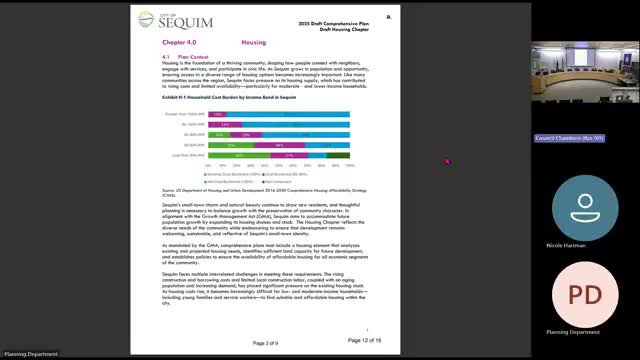
Summary
The Sequim Planning Commission reviewed the draft 2025 housing chapter, asked staff to add an AMI definition and dollar amounts, and discussed code incentives — an 'affordable housing exceptions' section, multifamily tax exemptions and modest city funds to encourage middle and affordable housing.
The Sequim Planning Commission on Nov. 18 reviewed the draft 2025 comprehensive plan housing chapter and signaled support for policy and code tools to encourage middle housing and long-term affordability.
Commissioners pressed staff to make the chapter clearer for residents by defining 'area median income' (AMI) within the narrative and including the current dollar figure. "We use the AMI consistently throughout this, though we don't define, a citizen looking at this won't ... understand," a commissioner said; staff agreed to move the AMI definition and the county family AMI figure (noted in the packet as $93,900) up into the first page of the chapter.
Why it matters: AMI thresholds determine which units qualify as affordable for program eligibility and for incentive programs. Commissioners emphasized that embedding the number in the narrative will help readers understand who will benefit from housing policies.
Policy tools discussed: Staff described a proposed 'affordable housing exceptions' section of code intended to incentivize deeply affordable projects by allowing increased density and reduced development standards in exchange for long-term affordability covenants (examples cited included 50-year affordability commitments). The staff presentation framed this approach as a non-mandatory alternative to inclusionary zoning, saying the city would rely on incentives, nonprofit partners and housing authorities to deliver subsidized units rather than imposing mandatory requirements that could 'chill' middle-housing development.
The commission also discussed the multifamily tax exemption (MFTE). Staff gave a multi-part explanation of MFTE options — shorter (7-year) market-rate exemptions and longer (10- or 20-year) exemptions tied to affordable-unit requirements — noting geographic boundaries, the potential to shift tax burden, and examples in other Washington cities where MFTE helped projects 'pencil' economically.
Local funding and developer outreach: Commissioners asked about a local affordable housing fund; staff confirmed there is an existing city fund (cited in discussion as roughly $150,000) and described possible limited uses such as permit fee waivers or small gap financing, noting it would not be large enough to build housing on its own. Staff said the city plans active outreach: participating on a county housing solutions committee, reinstating a developers forum in January, and meeting regularly with nonprofit and housing authority partners.
Next steps: Staff will add a clear AMI definition and dollar amounts to the chapter text, return in December with technical appendices prepared by Leland Consulting, and deliver a redlined comprehensive plan for commissioner review after the December meeting.