Get Full Government Meeting Transcripts, Videos, & Alerts Forever!
Get email alerts on the Comprehensive Plan topic
No spam. Unsubscribe anytime.
Sequim planning commission reviews capital facilities chapter; staff to bring participation plan and site-specific amendments
Summary
The Sequim Planning Commission reviewed the draft Capital Facilities and Utilities chapter of the 2025 Comprehensive Plan, questioned water and sewer capacity assumptions, discussed funding tools such as impact fees and leases, and directed staff to present a public participation plan to council and site-specific amendment applications at upcoming meetings.
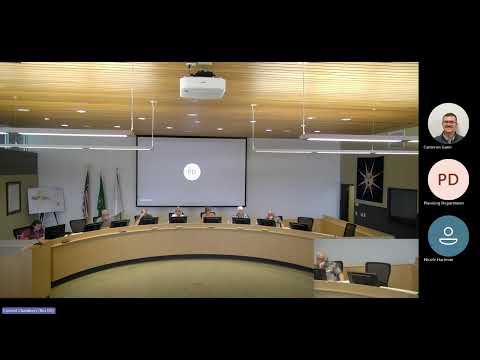
The Sequim Planning Commission on Sept. 2 reviewed the draft Capital Facilities and Utilities chapter of the 2025 Comprehensive Plan and requested staff follow-ups on public engagement and site-specific amendment applications.
Carla, a planning department staff member, told commissioners the department will delay a proposed Title 17 land-division ordinance and instead bring forward 11 site-specific amendment applications and a development-regulation update at upcoming meetings. She said she will present a public participation plan to the City Council for preliminary review on Monday and, if accepted, seek adoption by resolution on a consent agenda item later in the month.
The commission’s discussion focused heavily on utilities and growth assumptions. City engineer Nick Doste outlined technical standards the Department of Health uses when reviewing water-system plans, saying the residential minimum fire-flow standard is "1,000 gallons per minute" while maintaining a "20 psi" residual and that the design assumes a 60-minute fire duration. He said the city’s water-system plan assumes a 3% growth rate and that the system meets the level of service for that assumed rate.
Commissioners raised concerns about large proposed developments not included in the comp-plan land-capacity analysis. Alex and others cited the Seabrook/West Bay (John Wayne Marina/West Bay) proposal as a potential source of seasonal peak demand that could exceed base assumptions; planning staff responded that those projects are technically incomplete and therefore were excluded from the current land-capacity analysis but will be evaluated in project-specific master-plan review.
On financing and timing, staff explained the suite of tools available to the city for paying capital improvements: monthly user fees, general facility charges (GFCs), impact fees, leases and, where feasible, sale or long-term lease of unobligated city property. Nick said the city currently does not own unobligated parcels likely to support new affordable housing without title or use changes and pointed commissioners to public-works director Paul and finance staff Amy Doherty for detailed lease and revenue data. Staff also described how developer-funded interior improvements are required and how developers may be responsible for upgrades where system capacity (measured in equivalent residential units, or ERUs) is exceeded.
The commission also worked through wording fixes and policy clarifications: copy edits and hard-return formatting issues throughout the chapter; clarifying a Growth Management Act (GMA) concurrency parenthetical to state that facility improvements must be in place at the time of development or funded to be completed within six years; refining level-of-service (LOS) language to distinguish between infrastructure (e.g., water/sewer constrained by public-health standards) and other services (parks, transportation) where LOS adaptation may be appropriate; and adjusting a water-looping policy to emphasize both "water quality and delivery" and the reduction of stagnant (dead-end) mains.
Telecommunications policy prompted discussion about whether to name specific carriers. Commissioners recommended referencing local ISPs or listing current providers with a "formerly known as" notation rather than hard-coding company names, given frequent corporate changes. On wireless facilities, staff noted the municipal code already defines "stealth design" and that some zones require camouflaged facilities or height limits.
Nicole, the city council liaison, and other commissioners discussed landscaping standards near overhead power lines and the tradeoffs of undergrounding utilities: undergrounding is used for interior improvements and some capital projects where feasible, but it is costlier to install and repair, and decisions are often made during specific development review.
Votes at a glance
- Minutes: Motion to approve August minutes was made and seconded; the commission indicated the minutes passed (voice approval; no roll-call tally recorded).
- Adjournment: Commissioner (speaker 11) moved to adjourn; the motion was seconded and the meeting adjourned at 7:04 p.m.
What’s next
Staff will bring a public participation plan to City Council for initial review and will present the development-regulation work plan and the 11 site-specific amendment applications at upcoming Planning Commission meetings, including an anticipated presentation on Sept. 16 for the development-regulation work plan.
Quotes from the meeting
"We are continuing to move along on our list of topics," Carla said during the status update.
"The minimum is 1,000 gallons per minute, maintaining a 20 PSI residual," Nick said describing fire-flow requirements and Department of Health review standards.
Additional context
Planning staff said the comp-plan land-capacity analysis does not include technically incomplete 'pipeline' projects; such projects are typically captured in future comprehensive-plan updates or in project-level master-plan reviews. Staff recommended commissioners and interested parties contact public-works and finance staff for detailed lease and revenue breakdowns related to capital funding.
The meeting closed after staff answered final questions and thanked contributors from planning and public works.