Get Full Government Meeting Transcripts, Videos, & Alerts Forever!
Get email alerts on the Program Of Studies Update topic
No spam. Unsubscribe anytime.
Weston High proposes math, English, PE and ECE changes in Program of Studies update
Summary
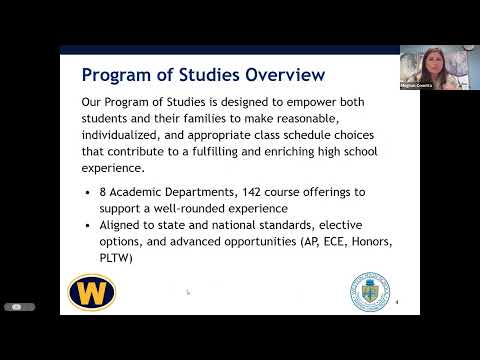
Weston High School leaders presented proposed updates to the 2026 27 Program of Studies, including a new integrated geometry-and-quadratics course to follow Algebra I Linear Equations, a return of English 12 to a year-long format, a restructured PE/health schedule, more accessible music electives and measured expansion of Early College Experience partnerships.
Weston High School presented a set of proposed changes to its Program of Studies at the Weston Board of Education curriculum subcommittee meeting on Dec. 3, 2025, citing student outcomes, scheduling constraints and state expectations as drivers of the revisions.
Principal Megan Kaneta and high school instructional leaders said the proposals are designed to increase access and consistency across student course sequences. "Our goal is for all students to graduate Weston High School with a minimum completion of algebra 2," Kaneta said, describing a new follow-up to last year's Algebra I Linear Equations course: an "integrated geometry and quadratics" class that blends quadratics instruction with geometry standards to build algebraic foundations.
Meredith Jackson, director of school counseling, described the student-facing timeline for the Program of Studies: the document is updated annually and is typically released in mid-January; students will review it during a packed lesson on Jan. 21 and receive 15 20-minute counselor appointments in February to discuss course recommendations and balance. "When we look at the expectations for students upon graduation, they need 25 credits to graduate," Jackson said, noting the mastery-based senior portfolio is part of that credit calculation.
Amy Holmes, the district—s secondary English curriculum leader, proposed reverting English 12 from the semester model back to a year-long course to restore a sustained professional writing strand and reduce scheduling disruptions that previously led to uneven elective enrollment. Holmes said honors, humanities and AP Literature options remain unchanged and that the year-long standardlevel English 12 would preserve student choice while allowing deeper writing instruction.
Liz Morris, the curriculum and instruction leader for music, proposed reinstating an accessible guitar course with songwriting and recording components to expand options for students who have not historically enrolled in music. Morris said the district currently has about 12 student guitars available and estimated student guitars cost roughly $150 each (including case). The item was framed as a materials request to be considered during the budget process.
Mary Faith Zange presented a restructuring of PE and health from a quarter/partial-credit schedule to full-semester courses for juniors and seniors, and combined ninth/tenth and 11th/12th groupings to allow semester pacing and course choice. Zange cited the 2024 Shape America standards and said the move is intended to "scaffold the content" and "provide a lot more time for application" of learning, while also freeing schedule space for academic supports and electives.
Staffing implications were discussed: Kaneta and presenters said implementation would likely require restoring a 0.2 full-time-equivalent position to the high school schedule (one full-year section equals 0.2 of a teacher's schedule, with five classes constituting a full load). The presenters characterized the change as "staffing neutral" in some cases but acknowledged there would be a slight increase in the PE budget for equipment tied to new unit offerings.
The presentation also described measured expansion of Early College Experience (ECE) offerings and university partnerships. Weston has approved videography and photography ECE courses and is working with the University of Connecticut and Sacred Heart University on options such as music theory; presenters said ECE overlays can yield three college credits for roughly $135 depending on the institution and require curricular alignment and instructor approval by partner colleges.
Board members and new subcommittee members asked clarifying questions about prerequisites, course sequencing and how ECE differs from AP credit. Megan Kaneta noted that state standards (Common Core-aligned expectations) provide broad learning goals and that districts design local course sequences to meet those standards and local student needs.
No formal policy votes on the Program of Studies occurred during the subcommittee meeting; the group discussed the proposals and flagged budget connections to be addressed in the district's upcoming budget cycle. The meeting adjourned by motion at the end of the hour.
Next steps: the Program of Studies will be finalized and released mid-January; students will be guided through course selection in January and February; the subcommittee will carry these proposed changes into budget planning and return with additional detail to the board as needed.