Get Full Government Meeting Transcripts, Videos, & Alerts Forever!
Get email alerts on the Martinez Career And Policy topic
No spam. Unsubscribe anytime.
Mel Martinez recalls arriving in Orlando as a teen, ties growth policy to school capacity
Summary
Former Orange County mayor and U.S. Housing and Urban Development secretary Mel Martinez described arriving from Cuba as a teenager, credited local families for helping his family settle, and said his county-era policy tied new development to school capacity — the approach the Orlando Sentinel called the “Martinez doctrine.”
Mel Martinez, who served as Orange County mayor and later as U.S. Housing and Urban Development secretary, paid tribute to the Orlando community’s role in his life and described a career shaped by local problems and national service.
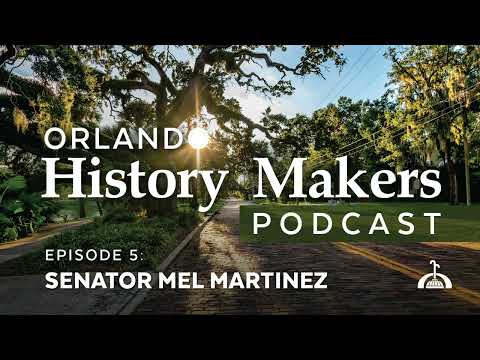
In a conversation with Orlando City Commissioner Robert Stewart on the Orlando History Makers podcast, Martinez recounted coming to Orlando from Cuba as a teenager during Operation Pedro Pan and living with foster families while learning English. "I came out... I was sent to a foster home in Orlando," Martinez said, describing how neighbors gave furniture, jobs and shelter that helped his family rebuild.
Martinez traced his path from local schools (he mentioned Bishop Moore and Orlando Junior College) to law school at Florida State and a private legal practice that connected him to civic leaders. He described being appointed to the Orlando Housing Authority and the Orlando Utilities Commission before running for Orange County mayor. Martinez said community leaders encouraged him to run and that he prevailed in a multi-candidate race for an open seat.
On growth and schools, Martinez described what he and local allies pursued as a policy to link development approvals to school accommodations. "If you're gonna add 300 homes ... we need to make an allowance, and we need to work with the school board," he said, noting that the Orlando Sentinel later labeled the approach the "Martinez doctrine." He acknowledged the policy was controversial with developers but said it was popular with residents and, in his view, the right move for maintaining school capacity and quality of life.
Martinez also recounted his transition to federal office, saying he became involved in the 2000 presidential campaign and was later invited to serve in the cabinet. He said his HUD confirmation was unanimous: "I managed well enough to get a confirmation, by the way, a 100 to nothing," Martinez said. He described the experience of attending his first cabinet meeting and the responsibilities of leading HUD, singling out homelessness and affordability as priorities. "I took very personal... the issue of homelessness," Martinez said, noting he hired staff focused on homelessness and worked to modernize housing programs.
The interview weaves personal history and policy: Martinez credited local leaders, recounted operational county decisions such as expanding the jail to meet demand, and urged public–private partnerships for complex problems like homelessness. He closed with advice for future leaders: "Leave your community better than you found it," Martinez said, listing environment, public safety and traffic management among priorities that define a community’s quality of life.
The episode includes references to Martinez’s autobiography, A Sense of Belonging, and points listeners to orlandomemory.org for more local material. The podcast did not record formal votes or policy enactments during the conversation; Martinez described past policies and decisions rather than proposing new, immediate actions.
The interview is part oral history and part policy memoir; it captures Martinez’s account of local initiatives (particularly the school-linked growth policy), his priorities as HUD secretary, and the community relationships that shaped his public service.