Get Full Government Meeting Transcripts, Videos, & Alerts Forever!
Get email alerts on the Transportation Infrastructure topic
No spam. Unsubscribe anytime.
Pavement survey rates Hickory streets 'fair'; city faces rising materials costs and funding choices
Summary
A pavement condition survey rates Hickory's city-maintained streets at an overall score of 69 ('fair'); staff warned asphalt and concrete price increases have widened a funding gap and outlined options including incremental budget increases, vehicle-fee changes, local legislation, or bonds to avoid decline to 'poor' by 2030.
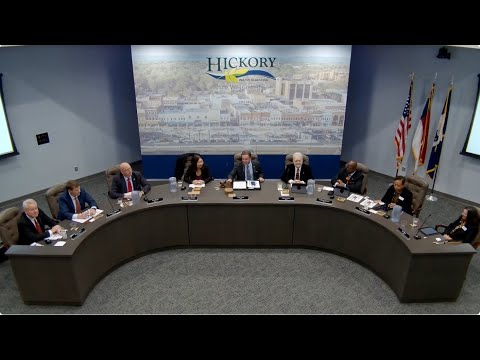
City Manager Warren Wood presented a pavement condition survey performed by Withers Ravenel Engineering and told the council the city’s street system received an overall rating of 69 (classified as "fair"). Wood said the city maintains about 240 linear miles (roughly 480 lane miles) of city-owned streets and that resurfacing needs will rise without additional funding.
Wood highlighted that the city’s paving/resurfacing allocations have increased about 233% over the last 30 years, but the asphalt-in-place cost per ton has risen about 371% in the same period, widening a funding gap. He cited Falling Creek Road — roughly 1.5 miles, two lanes — as a near-term resurfacing candidate and said resurfacing would include rumble strips and center-line work to address speeding concerns.
On sidewalks, Wood noted concrete costs increased from about $19.50 per cubic yard 30 years ago to roughly $145 per cubic yard today (a 640% increase), while sidewalk-construction funding has remained largely unchanged since 1999. Staff recommended council and staff retreat discussions in the spring to consider funding strategies and prioritization.
Council members discussed statutory constraints on revenue tools, pointing to property-tax limits, vehicle-fee adjustments (current $5; staff said the cap could go to $30 with $5 increments raising roughly $200,000 each) and the potential use of fund balance as a match to improve competitiveness for MPO and grant funding. Staff also noted bond issuances as an option for larger-scale streets programs but emphasized the need for an identifiable revenue source to service debt.
Wood: "Increasing our street resurfacing budget will be a priority for us if we want to keep that infrastructure in place and not fall in the poor category."