Get Full Government Meeting Transcripts, Videos, & Alerts Forever!
Get email alerts on the Primary Care Snapshot topic
No spam. Unsubscribe anytime.
HCAI convenes work group to build California ‘Health of Primary Care’ snapshot; Massachusetts team shares lessons
Summary
The Department of Health Care Access and Information (HCAI) convened a stakeholder work group to develop a statewide primary care snapshot, planning a 2025 brief, a 2026 static snapshot and a 2027 interactive dashboard; Massachusetts presenters highlighted how their MHQP/CHIA dashboard exposed declines in investment, workforce and equity and helped spur a task force and legislation.
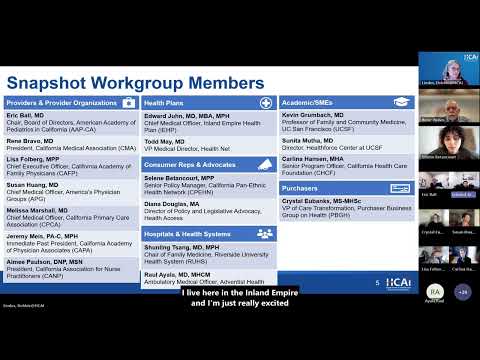
The Department of Health Care Access and Information’s Office of Health Care Affordability convened a Primary Care Snapshot work group and onboarded clinicians, payers, advocates and data partners to develop a statewide measure of the “health of primary care.” “We are super excited to convene this work group today and embark on the HCAI health of primary care in California snapshot with you all,” said Debbie Lindes, health care delivery system group manager at OCA.
Miranda Wirtz and Margaretta Brandt of HCAI described a phased plan: release an initial HCAI brief announcing the snapshot in early 2025, publish a static statewide snapshot report in 2026, and launch a full interactive dashboard in 2027 with annual updates thereafter. The snapshot will focus on five domains — investment/finance, workforce/capacity, access, care/quality and equity — and is intended to assemble existing HCAI and external data rather than collect entirely new sources.
The meeting’s featured presenters, Barbara Rabson of Massachusetts Health Quality Partners and Erin Bonnie of the Center for Health Information and Analysis, walked the group through Massachusetts’ experience building the nation’s first statewide primary care dashboard. Rabson said the dashboard “holds us all accountable,” arguing that combined indicators (spending, workforce losses and equity declines) were more compelling together than any single measure. Chia and MHQP manufacture the dashboard as a four‑part product: a static PDF report, an interactive Tableau view, a technical appendix with measure specifications and a data book with underlying tables.
Massachusetts examples the group reviewed included an equity breakdown and an access indicator showing that in 2023 “41.2 percent of residents reported difficulty obtaining necessary health care,” with higher rates seen in multiracial respondents, and a finance view showing MassHealth (Medicaid) had comparatively higher primary‑care spending while commercial payer shares continued to decline.
Work group members asked practical questions HCAI will need to resolve: whether and how to stratify rural versus urban areas, how to trace where investments and incentive payments actually reach practices, how to capture non‑claims investments (care management or ACO incentives) and how to measure team‑based care and practice ownership changes such as private‑equity or hospital acquisitions. Panelists said some of those data elements are not yet fully available and recommended an iterative approach that begins with the best available measures and expands as new sources are identified.
On tracing funds, Rabson and CHIA representatives said commercial payer incentive flows are especially opaque: while some payers report incentive programs, “how much money actually gets to the practice” is often not transparent and requires additional reporting requirements to be recommended and adopted. On definitions, the Massachusetts team said they aligned to a combination of provider taxonomy and services rendered and relied on the NASEM framing when selecting measures, while noting edge cases (for example, when urgent care services replace primary care access) that the task force continues to debate.
Presenters emphasized operational lessons: prioritize publicly available, documented data with a regular cadence; publish a technical appendix to preserve credibility; choose an initial PDF release followed by an interactive product; and coordinate public‑private partnerships for reach and legitimacy. Rabson recounted that sustained media coverage helped Massachusetts reach a policy inflection point and contributed to legislation establishing a primary care task force.
Next steps for HCAI: staff will circulate a draft work group charter for review, publish the 2025 brief early next year, and begin indicator selection during 2026 meetings. The HCAI work group’s next meeting is scheduled for January 14, when staff plan to begin deep work on indicator definitions and the work group charter. The session adjourned after the presentations and Q&A.
What the meeting did not decide: the group did not vote on any formal recommendations, did not adopt specific indicator definitions, and left open how HCAI will resolve data gaps such as money‑flow transparency and measures of non‑claims investment.