Get Full Government Meeting Transcripts, Videos, & Alerts Forever!
Get email alerts on the Behavior Education Plan topic
No spam. Unsubscribe anytime.
MMSD presents BEP update, spotlights school restorative practices amid persistent suspension disparities
Summary
School district staff presented multi‑year discipline and climate data, highlighted school practices (a calming room, alternative‑to‑suspension processes and restorative justice), and outlined potential Behavior Education Plan revisions to expand alternatives to suspension and clarify progressive discipline. No formal policy changes were voted on tonight.
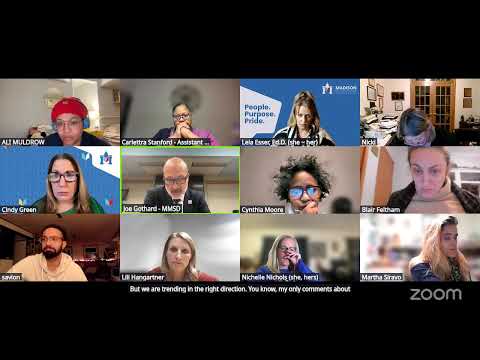
Madison Metropolitan School District leaders presented an update on the district’s Behavior Education Plan (BEP) and spotlighted three schools’ restorative and alternative‑to‑suspension practices during a board meeting.
The presentation, led by Executive Director of Student and Staff Supports Dr. Leah Eser and coordinator of progressive discipline Lily Hangartner, reviewed multi‑year behavior and suspension data since return from the pandemic. “The vast majority of our behaviors do fall in those levels 1 and 2,” Hangartner said, explaining BEP behavior levels that designate classroom‑managed incidents separately from those that may lead to suspension. She reported an uptick in suspensions in 2023–24 and a notable reduction in 2024–25, including “an approximately 30% decrease in middle school suspensions” for 2024–25.
At the same time, district data show persistent disproportionality: Hangartner said the aggregate figures suggest roughly a 1‑in‑10 chance any student might receive a suspension in a given year; students with disabilities face about a 2‑in‑10 chance for out‑of‑school suspension, and students identifying as Black about a 3‑in‑10 chance over the four‑year averaged window. “This resulting disproportionality, especially with respect to our Black students and to our students with disabilities, remains stubbornly disparate,” Hangartner said.
Cynthia Moore, teacher leader for Culture and Climate, reviewed the district climate survey (comparisons between 2024 and 2025). She reported consistent strengths in relationships with teachers (mid–high 80s across grade bands) and improvements in safety, particularly at middle school, while noting a slight dip in safety measures for students with IEPs at the elementary level and no percentage change for Black students in that band.
School spotlights: three models to reduce exclusionary discipline
District staff invited teams from Leopold Elementary, Georgia O’Keeffe Middle School and La Follette High School to present scalable practices.
• Leopold Elementary: Daniel Roller, school social worker, described “Tito’s Den,” a calming room with standard operating procedures and data collection. Roller said last year the space logged more than 1,800 visits by 230 unique students—about 35% of school enrollment—and that teacher feedback rates the space’s contribution highly. Ty Galloway, Leopold’s PBIS coach, described an Alternative‑to‑Suspension (A2S) process that offers students two opportunities to engage in targeted interventions (restorative conversations, SEL lessons, skill building) before escalation; Galloway reported 80 A2S completions last year for 42 students and that seven students reached the three‑or‑more threshold.
• O’Keeffe Middle School: Principal Matt Enda described a three‑year looping student services model that assigns a consistent student‑services cohort to a grade level across three years. He presented cohort data showing incidents falling from 56 to five for one tracked cohort as students progressed through the program, and emphasized dynamic instruction, co‑planning and co‑teaching to reduce incidents and stigma for students with IEPs.
• La Follette High School: Principal Matthew Thompson and restorative justice coordinator Torren Young described expanding RJ practices (facilitated circles, small‑group interventions and community partner support). Young said restorative conversations are documented separately from EduCLIMBER referral data; the team reported that in 2024–25, 47% of restorative conversations were used as alternatives to suspension and 83% of those alternatives were deemed successful (defined as no repeat incident related to the original conflict).
Board questions and district next steps
Board members pressed staff for further disaggregated data (especially by disability status), information about seclusion and restraint, and examples of how restorative practices are requested and documented. District staff said the restraint and seclusion report required by state reporting was provided to the board in October and that schools are working to integrate restorative practice documentation with existing behavior data systems.
District leaders outlined three connected areas for possible BEP revision: reaffirming guiding principles; clarifying expectations for progressive discipline and supportive interventions (including broadening alternatives to suspension for non‑physical behaviors); and reworking the behavior response grid to reduce subjective language and better integrate bullying policy. Lily Hangartner said the first phase of a proposed universal SEL curriculum will come as a consent item to the board in January and that any policy changes would be presented to the full board for vote before the next school year to allow training and family outreach.
What the board approved tonight
The board voted to approve meeting minutes from the November 3 instruction work group meeting and later voted to adjourn; no BEP policy changes were decided this evening.
Why it matters
District leaders framed the BEP as a tool to teach expected behavior and reduce exclusionary discipline that has unequal impacts on students of color and students with disabilities. The presentations highlighted programs that district staff say can be scaled or standardized—if staff can reconcile how restorative practice records and referral data are integrated and if the board and community approve proposed policy language changes.
What’s next
District staff will return with additional data and a consent item for the SEL curriculum in January; proposed BEP revisions and related policy language will be brought forward for board review and votes on a timeline intended to allow professional development and family communication before the next school year.