Get Full Government Meeting Transcripts, Videos, & Alerts Forever!
Get email alerts on the School Safety Mapping topic
No spam. Unsubscribe anytime.
East Bridgewater committee hears presentation on emergency‑response school maps from Critical Response Group
Summary
Hardy Allen of Critical Response Group demonstrated gridded reference maps for K–12 buildings, saying accurate, georeferenced interior and campus maps can speed 911, fire and police response. Committee members asked about costs, privacy and procurement; the district will solicit bids.
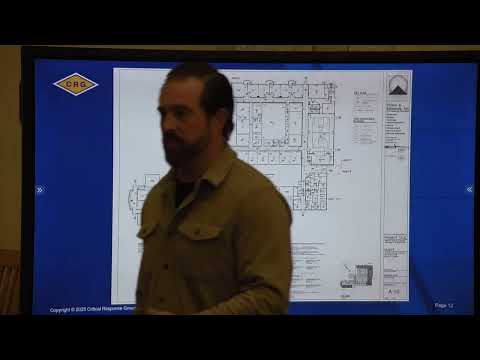
Hardy Allen, a presenter from Critical Response Group (CRG), told the East Bridgewater School Committee on Nov. 18 that standardized, georeferenced maps can reduce confusion during emergencies by giving responders precise interior locations and a common reference system.
Allen described CRG’s method of rotating existing floor plans to true north, overlaying aerial imagery and then conducting a 60–90 minute walkthrough to verify layout and add tactical details such as AEDs, bleed kits, knock boxes, camera locations and utility shutoffs. He said the company produces both micro (floor‑level) and macro (campus/approach) maps and delivers them in multiple file formats so 911 centers, patrol MDTs and fire tablets can ingest them.
“Simple solutions work best,” Allen said, explaining the gridded reference graphic (GRG) approach and citing examples where inaccurate schematics hindered response. He said CRG’s maps are georectified so each pixel corresponds to latitude and longitude, which can aid 911 call‑taking and mutual‑aid coordination.
Committee members pressed Allen on cost and maintenance. Allen presented a one‑time project price that averages about $4,000 per school, with variability based on square footage and number of floors (examples given for small one‑story elementary schools and large multi‑story high schools). He said CRG offers an optional maintenance/implementation program for roughly $500 per school per year to manage updates and training.
On privacy and dissemination, Allen said the district controls internal distribution and that tactical maps loaded into closed public‑safety systems (911/PSAP, police, fire) are not broadly published. He recommended providing sanitized internal‑use floor plans for classrooms while restricting sensitive tactical details to key stakeholders (SROs, facilities, principals and first responders).
Superintendent and committee members noted the cost requires competitive procurement; the superintendent said the district must go out to bid and expects to solicit at least three vendors and bring a recommendation to a future meeting rather than voting the same night.
The committee did not vote on a contract at the Nov. 18 meeting. If the district proceeds, Allen said CRG’s typical timeline from signed proposal to completed maps is two to four months but can be expedited for grant‑tied deadlines.