
Board debates enforcement steps: technical assistance, public testimony and performance plans
Get AI-powered insights, summaries, and transcripts
Subscribe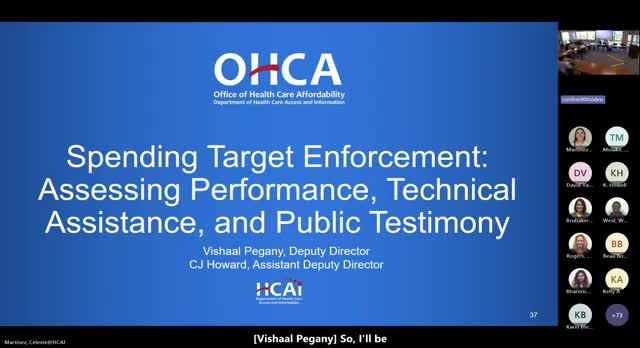
Summary
Board members spent extensive time defining 'technical assistance', how targeted performance improvement plans (PIPs) will be monitored, and whether the office should compel public testimony or grant waivers. Staff emphasized TA is high‑level guidance while PIPs would be specific and measurable; confidentiality limits and enforcement sequencing were central concerns.
At its meeting the Health Care Affordability Board discussed how the Office of Health Care Affordability will enforce spending targets, with sustained debate over the role of 'technical assistance' (TA), the mechanics of performance improvement plans (PIPs), the use of public testimony, and whether to implement waiver rules.
Deputy Director Vishal Pagani described TA as an informational letter to entities that exceed targets, containing research, models and examples of cost‑reducing strategies but not directing specific operational changes or serving as management consulting. Pagani said TA may be tailored in applicability to entity type but is, by statute, distinct from a PIP, which is a particularized, quantifiable corrective plan that the office would monitor.
Board members pressed staff on consequences and sequencing. "What exactly does it mean when we provide technical assistance and they follow it to the best efforts?" asked Dr. Richard Pan, underscoring the need to define how the office will evaluate adoption and whether following TA but still failing targets changes enforcement outcomes. Staff replied that TA does not substitute for PIPs and that PIPs — which may last up to three years — will include measurable milestones that OCA will monitor.
Members also debated public testimony, an optional enforcement step the director may require. Legal counsel Sheila Chitayan cautioned that confidentiality rules in statute limit what OCA can publish from entities' submissions and said public domain TA materials may be posted but entity‑specific confidential information cannot. Board members were split on compelling oral, on‑the‑record testimony; some said it would be punitive if used as a press‑driven 'call‑out' while others argued public testimony provides transparency and a forum for community members to respond.
On waivers, staff recommended not creating a broad waiver program at this time because the statutory 'reasonable factors' for waiver substantially overlap with enforcement considerations OCA can already weigh when deciding whether to advance an entity to further enforcement steps. Several members suggested waivers may be most appropriate for large, systemic events (for example, a widespread natural disaster) and could be revisited after the office gains more operational experience.
Public commenters — including Health Access California and a local advisory committee member — encouraged tailoring TA to entity type (hospitals vs. plans), warned against limiting innovative fixes to the PIP templates, and asked for clarity about public vs. confidential materials. The board did not adopt final rules on TA, public testimony or waivers but asked staff to return with clearer operational proposals, including how OCA will prioritize which entities proceed from TA to PIP and how confidentiality will be handled.
Next steps: staff will present additional materials on TA, public testimony logistics and PIP monitoring in subsequent meetings (PIP discussion slated for January/February).