
California announces state‑backed low‑cost insulin and advances rural health transformation plans
Get AI-powered insights, summaries, and transcripts
Subscribe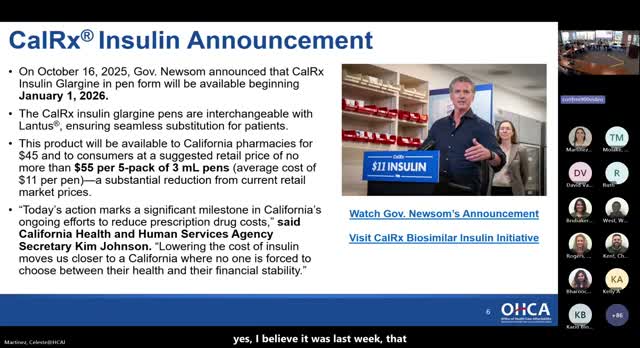
Summary
At a Health Care Affordability Board meeting, staff announced California’s Calyrex biosimilar insulin program — state‑backed glargine pens at a target retail price of $55 per five‑pack starting Jan. 1, 2026 — and described a federal rural health transformation application focused on hub‑and‑spoke care models, technology, and workforce development.
Director Landsberg told the Health Care Affordability Board that California will offer a state‑backed low‑cost insulin under the Calyrex initiative beginning Jan. 1, 2026, with insulin glargine pens priced at a maximum of $55 for a five‑pack and pharmacies able to purchase them for $45. "California has become the first state to offer its own low cost insulin starting on 01/01/2026," Landsberg said, framing the program as a way to reduce reliance on coupons and rebates and improve medication affordability for underinsured and uninsured residents.
The director credited state leaders and the Calyrex team for advancing a white‑label partnership and said the initiative fits into broader affordability work, including recent state legislation limiting cost sharing for insulin. Landsberg noted that current retail prices for a five‑pack of long‑acting insulin vary widely, “between $88 and more than $400,” and said Calyrex is intended to make insulin more accessible and transparent for consumers.
Landsberg also described HCAI’s outreach for California’s application to the federal Rural Health Transformation Program under HR1, a five‑year federal initiative with large discretionary funding for states. The state surveyed several hundred stakeholders and said it is focusing the application on three main areas: formalized hub‑and‑spoke care models to strengthen primary and maternity care in rural areas, investments in technology and shared technical assistance (including modernizing electronic health records and data exchange), and workforce development efforts such as "grow your own" pipelines and training for community health workers, midwives and behavioral‑health integration.
The board’s members and public commenters welcomed the announcements. Board member Richard Pan praised the transparency and noted legislative steps to cap co‑pays are only part of reducing overall pharmaceutical spending, while public commenters representing pharmacy and patient‑advocacy groups urged including community pharmacies and pharmacists in rural transformation plans. Landsberg said HCAI’s work also included the agency’s first formal tribal consultation to ensure tribal communities’ priorities — access to primary and maternity care and integration of traditional healing — are reflected in state planning.
What’s next: Landsberg said Calyrex’s pen product will roll out Jan. 1, 2026, and HCAI will continue stakeholder engagement on the rural health application as the state finalizes its federal submission.