Get Full Government Meeting Transcripts, Videos, & Alerts Forever!
Get email alerts on the Rates Solid Waste topic
No spam. Unsubscribe anytime.
Gilbert staff outline solid waste and recycling cost pressures, propose modest residential increase and larger commercial adjustments
Summary
Staff told council that vehicle replacement costs, rising landfill tipping fees and volatile recycling markets are driving rate pressures; staff proposed a 2% residential revenue increase (beginning April 2026) and about 20% additional commercial revenue, with a third‑party water audit to begin in 2026.
Isaiah Garcia Romero, Gilbert’s solid waste and recycling manager, told the Town Council on Dec. 16 that three primary pressures are driving up solid waste costs: sharply higher vehicle replacement prices, rising repair and maintenance for an aging fleet, and significantly higher landfill tipping and post‑collection fees.
Garcia Romero said industry lead times and component costs pushed side‑loader replacement costs from roughly $285,000 pre‑2020 to more than $525,000 today, increasing vehicle replacement costs by about 87% since 2020. He said the town has a backlog of vehicles past their replacement cycle (industry standard seven years), contributing materially to higher repair bills.
Staff also cited landfill and post‑collection costs rising: the presentation reported landfill tipping fees rising (staff cited $3,400,000 post‑COVID as a figure used in the model) and an increase in annual post‑collection expense from about $3.8 million in 2023 to about $5.5 million most recently. Garcia Romero described recycling‑market volatility—softening commodity prices and processor closures—that has reduced revenue from recyclables and increased processing costs.
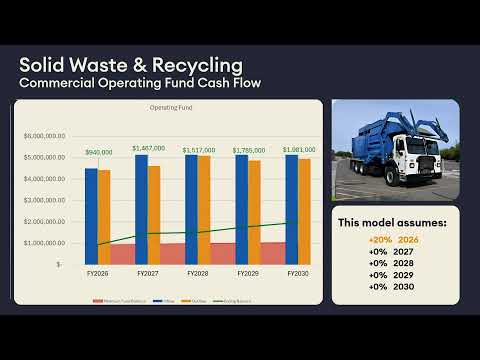
To address these pressures, staff presented a five‑year financial model. For the residential solid waste and recycling fund, staff said a 2% revenue increase beginning April 2026 would be needed to keep the operating fund above minimum balances; staff stated that would translate to roughly a $0.55 monthly increase for the standard 90‑gallon curbside service. For commercial services, staff said the model requires approximately 20% additional revenue to right‑size commercial rates; an example showed a 3‑yard commercial container’s baseline monthly rate would increase from about $95.79 to $108.23 under the proposal.
Staff noted mitigation steps underway: a third‑party water‑billing audit (Kimley Horn and Associates) with preliminary findings expected in March 2026, drop‑off glass recycling (five town sites) that has produced net rebates to the town, pilot battery drop‑off sites to reduce truck‑fire risk, and Goodwill donation containers to divert material at no cost to the town.
Council questions focused on whether the five‑year plan properly accounts for inflation and on whether landfill pass‑through escalation should be indexed to a CPI measure. Staff said some inflation is included in the model but landfill escalation is a pass‑through cost they are exploring indexing to avoid repeated council approvals for vendor increases.
Next steps: staff said formal rate adoption would follow required notice and hearing procedures (staff noted a tentative formal adoption date of Feb. 27) and encouraged the public to use forthcoming project hotlines and materials to raise billing discrepancies during the audit and outreach period.