Get Full Government Meeting Transcripts, Videos, & Alerts Forever!
Get email alerts on the Parking And Lighting topic
No spam. Unsubscribe anytime.
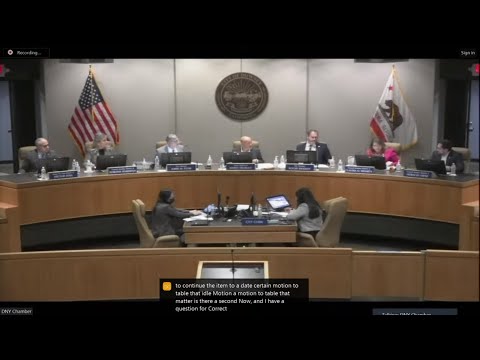
Downey council debates lowering thresholds for preferential parking and expands streetlight pilot
Summary
Council discussed reducing the petition threshold for preferential parking (proposal to lower from 75% to 60%) and debated a residential streetlight pilot that favors solar fixtures; staff were directed to return with prioritized block lists, threshold options and cost estimates.
Public Works Director Matt Baumgartner briefed the council on the city's preferential parking district program and a residential streetlight pilot. Baumgartner explained the ordinance criteria for creating a preferential parking district (e.g., 75% single-family composition, 75% occupancy during study periods and at least 50% of parked spaces occupied by non-residents) and described typical steps (eligibility study, formal petition, public hearing).
A councilmember moved to reduce the petition signature threshold for establishing a preferential parking district from 75% to 60%; the motion was seconded and discussion followed. Councilmembers raised practical concerns: many owners are off-site or renters cannot legally sign petitions, summer door-to-door contact rates are low, and property owners may be reluctant to accept an additional annual maintenance charge that would appear on their property tax bill.
On streetlights, Baumgartner reviewed the $50,000 pilot and subsequent $150,000–$200,000 capital funding available this fiscal year. Staff recommended solar LED fixtures (~$7,000 per light) as a lower-cost, faster option compared with $20,000–$25,000 for traditional connected lights. The two-block pilot produced mixed results: one block had about 69% participation but only 44% yes votes; the other block had a 38% participation rate.
Council explored a three-tier approach: prioritize multifamily areas (no petition threshold), lower the petition threshold for residential districts (staff suggested 50%–60%) and develop a prioritized list of blocks (33 had expressed initial interest). Council asked staff to return with recommended thresholds, a prioritized list of the 33 interested blocks and cost implications for phasing a broader program. Staff noted an estimated 1,100 lights would cost roughly $7.7 million to fully light the city.