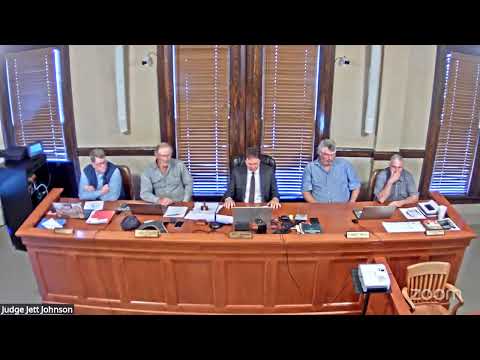
Mills County court rejects tax abatement for Blue Heron solar project in 3–2 vote
Loading...
Summary
After hours of public comment and legal review, Mills County commissioners voted 3–2 to deny a proposed 35% tax abatement for the Blue Heron (Red River) Solar Project, citing questions about meeting county guidelines and a desire to review the full contract before granting incentives.
Mills County’s commissioners voted 3–2 on Dec. 29 to deny a proposed tax abatement for the Blue Heron Solar Project, rejecting a 35% pilot payment arrangement the applicant had offered and instead leaving the property subject to standard ad valorem taxation.
The decision followed more than two hours of public comment, presentations by project representatives and attorneys, and an extended legal discussion about whether the proposal met county guidelines requiring a net economic benefit of $10 million over the abatement period. The presiding judge moved for zero abatement; the motion was seconded by Commissioner Depp and passed with three votes in favor and two opposed.
Project representative Bill Pentec (presenting on behalf of Red River Clean Energy/Blue Heron) told the court the $267 million project ‘‘will generate $17,400,000 in tax revenues for Mills County’’ under earlier valuation scenarios and that the company had reduced its original 50% abatement request to 35%. Pentec also said the company would pay 100% of land taxes, accept three-year rollback payments required by law, and offer community benefits including the donation of a fire truck to a volunteer department.
County counsel and the applicant’s attorneys outlined how a pilot payment (a fixed in-lieu payment) works compared with standard appraisal of property; staff estimated a 35% pilot payment would be roughly $615,000 annually. Attorneys also explained the abatement agreement can include job-creation requirements and liquidated-damage penalties if employment targets are not met, and they discussed a typical 12-year local-stay requirement for the operation spelled out in draft agreements.
A county attorney reading of the court’s adopted guidelines prompted substantial debate. Richard Allen (reading guideline text during the meeting) noted that the guidelines require a ‘‘net economic benefit averaging $1,000,000 a year’’ (or $10,000,000 over a 10-year abatement period) and minimum permanent full-time employee thresholds; he said, as presented in the application, Blue Heron may not meet those thresholds without either including certain items in the net-benefit calculation or the court formally amending the guidelines.
Members of the public expressed both practical and policy objections. Speakers cited concerns about visual and noise impacts on neighboring landowners, decommissioning and cleanup responsibility after storms or operator failure, potential supply-chain questions (including whether components are imported), and the risk that non-solar uses (such as large data centers) could be permitted under reinvestment-zone language unless explicitly restricted. Chris Curzon asked the court to ‘‘hold them to’’ the company’s $17.4 million figure and to prohibit AI or data centers on the site; Spring Grossenbacher said local Facebook groups showed ‘‘overwhelming disapproval’’ of tax abatements for the project.
Several commissioners said they did not have the final contract or road‑use and infrastructure terms in hand and wanted those documents available before approving a significant incentive. Staff suggested the court could adopt a percentage subject to the final agreement, but the court instead voted to deny any abatement.
The motion to adopt a zero percent abatement passed after the vote was called; the presiding officer announced the outcome as ‘‘No tax abating’’ and thanked attorneys and citizens. The court then adjourned.
What the vote means: With no local abatement approved, the project would be treated under standard property appraisal and taxation unless the applicant returns with a different proposal or the court later amends its guidelines or approves an alternative incentive. County officials said they would continue discussions about draft contract language, road‑use agreements and enforceable job and decommissioning provisions.
Speakers quoted in the article are taken from the public meeting transcript and include public commenters and the applicant’s representative. The court announced the motion, second and vote on the record; the meeting adjourned immediately after the vote.