Get Full Government Meeting Transcripts, Videos, & Alerts Forever!
Get email alerts on the Natural Environment topic
No spam. Unsubscribe anytime.
Sequim Planning Commission reviews Natural Environment chapter; debates wetlands wording, tree policy and scheduling
Summary
The Sequim Planning Commission reviewed the draft Natural Environment chapter on June 17, clarifying that wetland delineations rely on state guidance, debating wording to ensure perpetual wetland protection, and discussing tree-retention language and shoreline references; staff noted schedule adjustments for related chapters.
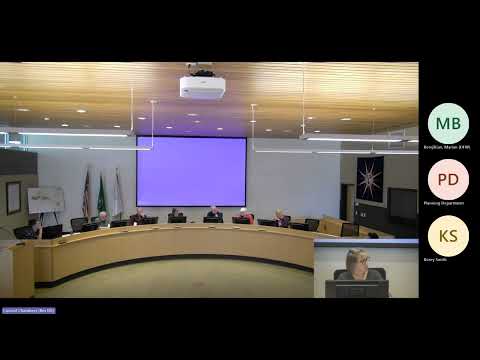
SEQUIM, Wash. — The Sequim Planning Commission on June 17 reviewed the draft Natural Environment chapter of the city’s comprehensive plan, where commissioners pressed staff on who designates wetlands, asked for clearer long-term protection language and discussed how the Shoreline Master Program and tree-retention policies should be reflected in the plan.
Carla, planning staff lead on the chapter, told commissioners the section compiles requirements and guidance from the Growth Management Act and other state resources and covers critical areas, shoreline policies, energy conservation and urban forestry. “A lot of them are going to reflect the critical area protection requirement from the state law under the Growth Management Act,” Carla said, noting the chapter is largely a policy foundation rather than parcel-level regulation.
Why it matters: the Natural Environment chapter sets policy direction for wetlands, critical aquifer recharge areas (CARAs), shoreline jurisdiction and tree retention that will later inform the city’s development regulations and project reviews.
Wetlands and critical areas: who decides and who protects Commissioners asked who determines whether land is a wetland. Carla responded that wetland delineation follows the Washington State Department of Ecology’s wetland delineation manual and the U.S. Army Corps of Engineers’ standards; developers typically hire wetland biologists to perform delineations and the city confirms those delineations and applies local buffer standards. “The Department of Ecology and the Army Corps of Engineers … say this is wetland, and then the city is required to protect the wetland,” Carla said.
Commissioner Dennis flagged policy NE 2.1, saying its current wording could be read to require protection only “during development.” He suggested rewording the last sentence to require protection “during all phases of development” or deleting the phrase “during development” so protections are understood as ongoing. Carla agreed deleting the phrase could address the concern.
CARA guidance and fish-habitat work Staff said the city’s Critical Areas Ordinance already contains CARA protections and that the commission will incorporate updated state guidance when the code is revised. On salmon and culvert work, a staff speaker summarized litigation and implementation context for nearby restoration projects, citing a Ninth Circuit decision from 2013 and noting that, after appeals concluded, state-driven culvert replacement work is proceeding with tribal consultation.
Shoreline Master Program and maps Commissioners and staff discussed whether to include Shoreline Master Program (SMP) policies verbatim in the chapter. Carla said she prefers referencing or incorporating high-level SMP goals by reference to avoid adding pages of SMP text, but she offered to draft a concise signpost and policy tying shoreline development to the SMP if commissioners want greater clarity.
Urban forestry and legacy trees The Parks, Arbor and Recreation Board (PARB) reviewed the chapter and recommended edits: replace the word “preserve” with “conserve” and delete the undefined term “legacy trees.” Staff and commissioners discussed tree-retention options and agreed that substantive private-property tree regulations would be better addressed later as part of the development regulations update, while the chapter can provide policy foundation.
Maps and technical work Staff highlighted new plan maps prepared by GIS intern Jack; the maps are high-level for the comprehensive plan documents but were produced at parcel level in GIS to support future development review.
Scheduling and next steps Staff said the parks and open space chapter previously scheduled for July 1 may be delayed because PARB meets only once monthly (next meeting July 21). The transportation chapter is tentatively scheduled for July 15 and the climate and resiliency chapter could come before the commission on Aug. 5. Commissioners tentatively agreed to keep July 1 as a placeholder but expressed reluctance to meet only to review preliminary drafts.
Director’s report and administrative items The director reported that the commission’s rules of procedure were presented to City Council and would appear on the council consent agenda. Staff also confirmed the final grant deliverable was provided to the Washington State Department of Commerce: “the check’s in the mail,” Carla said. Earlier in the meeting the commission approved the June 3 minutes as corrected. The meeting adjourned at 06:26.
What’s next: staff will revise draft wording on wetlands and consider a brief incorporation-by-reference or signpost for the Shoreline Master Program; the commission will continue reviewing comprehensive plan chapters as scheduled and will address development regulations later in 2026.