Get Full Government Meeting Transcripts, Videos, & Alerts Forever!
Get email alerts on the Transportation Pch Cdp topic
No spam. Unsubscribe anytime.
Malibu planning panel continues Caltrans’ PCH rehab permit after hours of public comment and technical questioning
Summary
The Malibu Planning Commission continued Caltrans’ Coastal Development Permit No. 25,009 to Nov. 3 after hours of testimony urging stronger, physically protected safety measures, and residents warning the project could erode Malibu’s rural character. The commission asked Caltrans to return with lighting plans showing existing vs. proposed fixtures, bike-lane options with parking‑loss estimates, and clarified sidewalk and retaining‑wall designs.
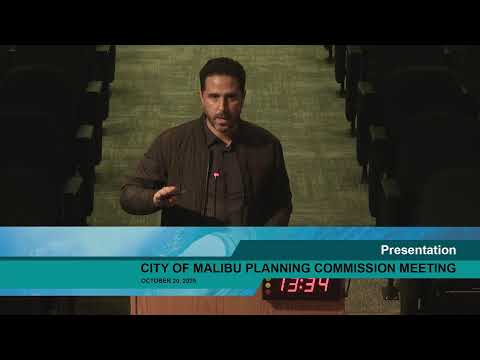
The Malibu Planning Commission on Oct. 20 took no final action on Caltrans’ 16‑mile Pacific Coast Highway pavement rehabilitation project, instead continuing the Coastal Development Permit (CDP No. 25,009) to Nov. 3 and directing Caltrans to return with more detailed plans and trade‑off analyses.
Caltrans presented a package of safety and pavement improvements that includes 19 upgraded guardrails, 22 upgraded curb ramps, about 6,956 linear feet of new sidewalks, three short retaining walls (none taller than 5 feet), two T‑intersection realignments, law‑enforcement pullout lanes, and roughly 42 new light poles (Caltrans said 38 would be inside Malibu). The agency said northbound work would be split across 14 bike‑lane segments (about seven miles) and southbound across 15 segments (a little over eight miles) and that construction could start in 2026 and run through 2028.
Commissioners and the public spent more than two hours on technical details and community impacts. Supporters of Caltrans’ proposal urged the commission to act quickly to reduce roadway deaths and injuries. “These improvements will save lives, and I respectfully urge this commission to grant the coastal development permit for this project,” Justin Orenstein, transportation deputy for L.A. County Supervisor Lindsey Horvath, told the panel, referencing a January 2024 road safety audit and local collision data.
Opponents argued the package as presented would over‑urbanize the highway and fail to protect the town’s rural night skies. “We are unalterably opposed to the addition of 42 street lights,” said a commenter, arguing Caltrans had not justified the locations. Several residents, including long‑time motorists and local commissioners, said they found multiple proposed new poles concentrated in short stretches and asked Caltrans to show existing lighting on plan sheets rather than add duplicate illumination.
Much of the hearing turned on trade‑offs Caltrans officials said the agency weighed: evacuation and emergency vehicle access, right‑of‑way constraints that limit protected (class 4) bike lanes, and the short‑term nature of a pavement‑rehab contract versus a longer master plan that would require a higher level of environmental review. Caltrans engineers said the project is a pavement‑rehab with safety “enhancements,” not the long‑term master plan; they told the commission that some measures (for example, protected lanes requiring additional right‑of‑way) will need a separate feasibility study and additional environmental review.
Commissioners coalesced around several specific requests for Caltrans to address before the next hearing: (1) plan sheets that show existing lighting and the proposed new fixtures and an analysis of whether minimal intersection lighting could meet safety objectives while reducing the total number of new poles; (2) two bike‑lane scenarios — the current segmented class‑2 striping plan and a contiguous option showing how many parking stalls would be lost at each segment; (3) dimensioned sidewalk sections and retaining‑wall details for the John Tyler–Malibu Canyon and Corral Canyon areas, plus documented outreach with Pepperdine University and local HOAs on the Malibu Canyon sidewalk; and (4) an assessment of which construction activities could be scheduled at night to reduce daytime traffic impacts, recognizing cost and noise trade‑offs.
The commission also noted administrative constraints: staff said the project is exempt from CEQA under the sections cited by Caltrans and warned that Caltrans has a funding deadline — the city’s CDP must be approved in time for Caltrans to keep state funding commitments (staff said there is a funding allocation timeline that makes the Nov. 13 CTC/award window important). Caltrans staff asked the commission to make its recommendations in writing so engineers could rework the plans and remain within funding and schedule constraints.
At the end of the item the commission voted unanimously to continue the matter to Nov. 3, 2025. Chair Leonard summarized the commission’s priorities as pursuing demonstrable safety gains while limiting unnecessary lighting and preserving Malibu’s rural character where feasible. The continuation directive requires Caltrans to return with the requested comparative analyses and plan sheets.
What’s next: Caltrans is to present the revised materials on Nov. 3; the commission and staff will use the new sheets to consider whether the findings for the CDP can be made. The City‑staff notices and Caltrans’ Oct. 22 virtual town hall remain public outreach opportunities in the interim.
Votes at a glance: The motion to continue the Caltrans CDP to Nov. 3 passed by unanimous roll call (Chair Leonard, Commissioners Kamens, Mazza, Peake and Vice Chair Riddick — all “yes”).