
Crete Public Schools: $13.4 million in grants fuels programs but reimbursement timing complicates budgeting
Get AI-powered insights, summaries, and transcripts
Subscribe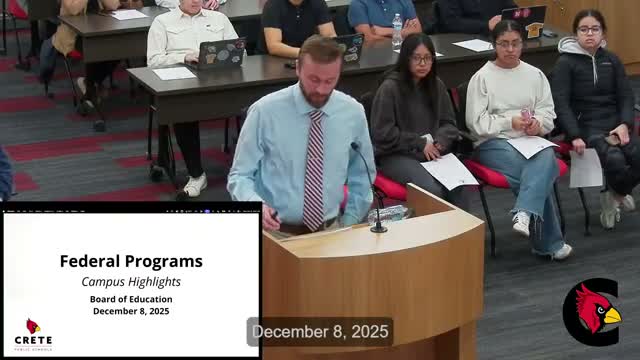
Summary
Joel Bramhall told the school board the district secured about $13.4 million in grant awards over three years—mostly federal—and that multi-year award cycles and reimbursement timing complicate budgeting and cash flow for programs and personnel.
Joel Bramhall, director of federal programs for Crete Public Schools, told the school board the district’s grant portfolio totaled about $13,400,000 in awards across three school years, with nearly $12,000,000 coming from federal sources, just over $1,000,000 from state awards and roughly $500,000 from private funders.
Bramhall said the district relies on three primary funding streams—federal, state and private—and warned that timing and award type affect how money appears in district accounts. "What we see is the annual funding awards, and what they've amounted to is $13,400,000," he said, adding that carryover, reallocation and matching funds were excluded from that figure.
The presentation distinguished formula and discretionary awards: formula grants typically award larger amounts per award, while discretionary grants are more numerous (Bramhall said discretionary awards averaged about $53,000 each). He cited examples including Title programs under the Every Student Succeeds Act and IDEA for special education, and named state examples like the Nebraska early childhood endowment and private funders such as EducationQuest.
Bramhall emphasized administrative burdens tied to grant acceptance: awards carry terms and conditions, reporting obligations and compliance requirements that become part of the district’s operational workload. He also noted that reimbursements can be slow and that multi-year grants often overlap district fiscal and calendar years, complicating budgeting and cash flow.
On deliverables, Bramhall said grants supported staff and services across the district: over the two-year span he described, grants fully or partially supported 89 full-time and 45 part-time positions and annually funded roughly a dozen classroom teachers, special-education staff, a speech pathologist, early-childhood educators and nutrition service roles.
Bramhall also described noninstructional uses and awards: the district’s arboretum won an international award for digital content, and a virtual tree map created with grant support documents plantings with multimedia and alumni stories.
The board did not take action on grant policy at the meeting; Bramhall’s materials and the presentation will be posted on the district website and he offered to answer follow-up questions to support budgeting and grant-management planning.