Get Full Government Meeting Transcripts, Videos, & Alerts Forever!
Get email alerts on the Affordable Housing topic
No spam. Unsubscribe anytime.
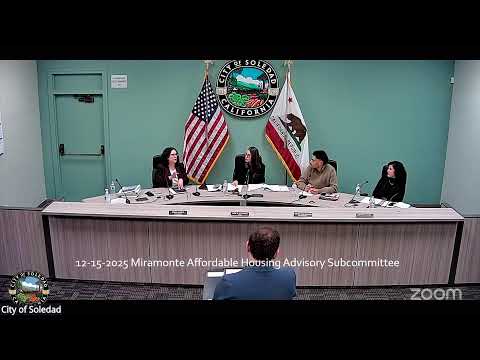
Soledad committee discusses 'duet' homes and senior apartments for Miramonte phases 1 and 2
Summary
The Miramonte Affordable Housing Advisory Subcommittee reviewed a developer proposal to deliver 'duet' ownership units and a senior apartment complex in phases 1–2, heard a LandWatch legal checklist for an affordable-housing agreement, and asked staff for corrected cumulative unit tables before any formal action.
Soledad City’s Miramonte Affordable Housing Advisory Subcommittee on Dec. 15 reviewed a developer proposal to use a two-unit "duet" housing typology and a senior apartment complex in the first two phases of the Miramonte specific plan, and requested clearer cumulative accounting before advancing any development agreement.
Beatriz, a community and economic development staff member, told the committee the Miramonte master plan envisions 2,392 housing units across 10 phases and that the city’s inclusionary housing ordinance requires 479 affordable units overall, which the presentation broke down as 144 very low‑income, 144 low‑income and 191 moderate‑income units. The committee focused its discussion on phase 1 and phase 2, where staff said 20% requirements translate to 63 units for phase 1 and 114 units for phase 2.
Laura Davis, speaking for LandWatch during public comment, urged the city to require a legally binding affordable‑housing agreement consistent with the specific plan and the inclusionary ordinance. "The developer is legally required to enter into an affordable housing agreement that is consistent with the specific plan as well as the applicable general plan," Davis said, and she listed that the agreement must address on‑site concurrency, rental mandates, and the specific‑plan requirements for small multi‑family housing types.
The developer and an Eden Housing partner presented a revised approach that replaces previously proposed accessory dwelling units with 46 duet units in phases 1 and 2 and a senior apartment complex sized—as presented—around 60 units. A developer representative described duets as "a way for us to meet our inclusionary obligation while also trying to be cost effective," saying the typology can reduce upfront infrastructure costs by clustering units near phase‑one streets and utilities.
Committee members pressed staff and the developer on several points: whether overproducing moderate units early would reduce later delivery of low and very‑low units; whether senior apartments would be age‑restricted; and how concurrency language in the inclusionary ordinance would be enforced in practice. Beatriz and other staff emphasized that cumulative accounting is used so that early overproduction can carry credit forward, but the city prefers concurrent, on‑site delivery of required units where feasible. On age restrictions, staff and the developer said product type will depend on funding sources and that program rules can limit eligibility (for example, a 55+ restriction when required by a funding source).
The committee also identified inconsistent unit totals on a slide during the presentation. Armenta, a staff member who said she tracks cumulative unit tables, explained that some slide totals were cumulative and offered to return with clear tables and a chart showing how early production affects later phases and RHNA accounting. "I have kept tables on this from day 1," Armenta said, and offered to provide the committee with the cumulative breakdown.
No formal motion or vote was taken. The subcommittee asked staff and the developer to return with corrected, cumulative unit tables and a clarified map of where duet and senior units would be sited. Members agreed to meet regularly while the development agreement is negotiated (the committee discussed a standing second‑Monday monthly cadence) and noted that the item will go to the full council when staff and developers bring a packet prepared for action.
What's next: staff will provide cumulative unit tables, corrected slides and a chart reflecting crediting across phases; the developer will refine siting and financing details; and the item will return to the subcommittee and, when ready for action, to the full council.