Get Full Government Meeting Transcripts, Videos, & Alerts Forever!
Get email alerts on the Wastewater System topic
No spam. Unsubscribe anytime.
Columbia Falls wastewater team warns plant and collection mains could reach capacity by 2030; lift stations lack permanent backup power
Summary
Consultants told Columbia Falls residents the wastewater treatment plant is close to its nutrient-limited capacity (roughly 0.68–0.71 MGD) and several gravity mains and lift stations are overcapacity under existing or approved-project scenarios; they suggested upgrades, additional dewatering capacity, and planning for redundancy.
Consultants from Morris & Marley and associated engineers told the Columbia Falls open house that the city’s wastewater treatment plant and portions of the collection system are approaching operational limits under current trends and projected growth.
CR Leasinger, a wastewater project engineer on the team, said the service population (including Meadowlake sewer district) is about 6,700 and the project team selected a 2.3% growth rate for the PER’s 20-year planning horizon. Using that basis, the 20-year service population for the city is roughly 9,372. Leasinger said plant capacity modeling shows a capacity ratio in the range of about 0.68–0.71 and projected that, under the chosen growth scenario and approved projects, the plant could reach its practical capacity by around 2030 without upgrades.
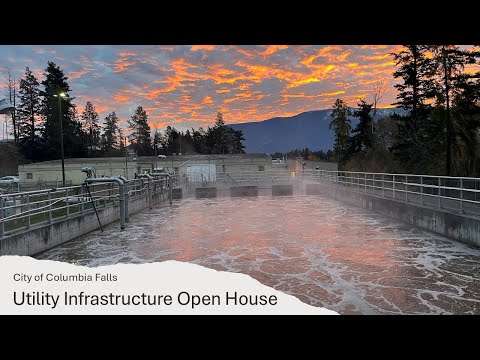
The presenters described the plant’s treatment train, noting a multi-stage (five-stage) bioreactor configuration that removes nutrients (nitrogen and phosphorus). "For a community of this size, this treatment plant is quite sophisticated," one presenter said, and the plant currently meets permit limits for nutrients. They identified the nutrient-removal configuration and some pumps, clarifiers and UV units as aging and potential near-term upgrade needs. The team said redundancy will become an issue if a clarifier or major component must be taken offline for maintenance.
On the collection side, the engineers said certain gravity mains and several lift stations are overcapacity in existing peak or projected scenarios; red-line areas were shown on maps indicating overloaded segments. They also said none of the lift stations have permanent backup power and that the city currently uses portable generators during outages—an operational risk the PER will examine.
Presenters also highlighted solids handling constraints: biosolids are dewatered and hauled to the county landfill, but county limits on liquid content are tightening and may require improved dewatering or alternative disposal approaches in the near term.
City staff said alternatives analysis in the PER will consider parallel bioreactor addition, pump and clarifier upgrades, lift station upgrades and permanent backup power, and options for biosolids handling. The team emphasized that cost estimates will be developed in subsequent PER chapters and that the city will refine phasing, including possible use of available state land for expansion.
Ending: The wastewater team invited follow-up questions at the display boards and said the PER will present alternative solutions, cost estimates and timing in the coming months.