Get Full Government Meeting Transcripts, Videos, & Alerts Forever!
Get email alerts on the Water System topic
No spam. Unsubscribe anytime.
Columbia Falls engineers find water source and some mains near capacity; additional well and storage recommended
Summary
Consultants reported Columbia Falls' water system meets minimum storage but is slightly undersized for maximum-day demand, with a transmission main and several hydrants failing fire-flow goals; consultants recommended evaluating an additional well, redundant storage, and targeted main upgrades.
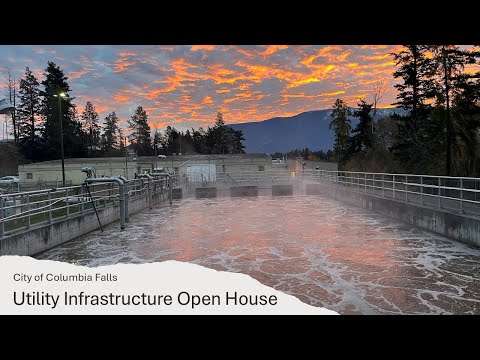
City staff and consulting engineers presented a preliminary engineering report (PER) update for Columbia Falls' water system, saying the existing supply and some distribution components are close to their operational limits and will need upgrades or additions as growth proceeds.
Consultants from WGM said Columbia Falls currently uses three municipal wells, about 2,050,000 gallons of storage in a single ground-level concrete tank, roughly 44 miles of mains, and about 2,292 service connections. Using seven years of meter and production data, the team said average daily demand is about 1,400,000 gallons, maximum-day demand about 3,490,000 gallons, and peak-hour equivalent flows near 6,980,000 gallons per day. "With the maximum well out of service, the existing wells would be able to produce 3,020,000 gallons for two wells running 24 hours," Stephanie Reynolds, senior project engineer with WGM, said during the open house.
Reynolds said DEQ Circular 1 requires that groundwater supply sources meet or exceed maximum-day demand with the largest well out of service. Based on that standard, the consultants concluded the current source capacity is "slightly undersized" for existing maximum-day conditions and that adding or evaluating an additional well is warranted. The team also flagged a transmission main from the storage tank into the distribution system as undersized, producing elevated head loss during peak demands.
Modeling maps shown at the open house indicated generally adequate pressures across most of the city (roughly 60–110 psi) but identified hydrants and nodes that do not meet land-use-based fire-flow criteria (1,000 gpm for low/medium residential, 2,500 gpm for commercial/high-density residential, and 3,500 gpm for industrial). Reynolds urged attendees to review the maps posted at the meeting to see which neighborhoods are affected.
On storage, consultants calculated the minimum allowable volume (average day demand plus fire flow) at roughly 1,870,000 gallons and noted the city has about 2,050,000 gallons of storage—meeting the minimum but offering limited redundancy. "You're about at the capacity of what your system requires," Reynolds said, recommending planning for additional redundant storage to preserve operations during maintenance or outages.
City Manager Eric Hanks said the PER work will inform funding and phasing decisions. He noted that Columbia Falls has not increased water and sewer rates in about 10 years, which constrains revenue available for modernization. Hanks also said staff will provide a list of approved but not yet built developments after the meeting; he estimated a committed population of about 500–700 residents not yet reflected in current conditions modeling.
The consultants said the PER update will model 20-year future conditions, evaluate alternatives, and identify projects, with the final PER update scheduled for April–May and a follow-up public meeting in February to present future scenarios.
Ending: The open house concluded with an invitation to review maps and speak with engineers and staff at display boards. Officials said next steps include incorporating approved developments into future-condition modeling and refining cost estimates and phasing options in the PER.