Get Full Government Meeting Transcripts, Videos, & Alerts Forever!
Get email alerts on the Housing topic
No spam. Unsubscribe anytime.
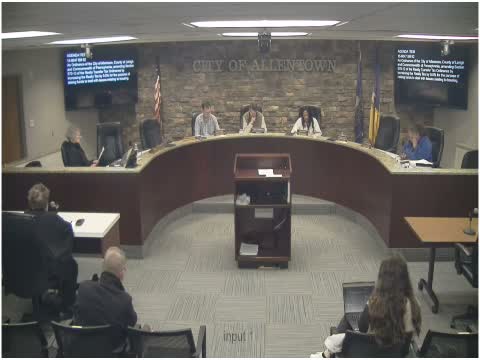
Committee advances Bill 92 to raise deed transfer tax 0.5% to fund Allentown housing programs
Summary
A Community and Economic Development committee voted to forward Bill 92, proposing a 0.5 percentage-point increase to the deed/realty transfer tax to seed a CED-managed housing fund; supporters cited a study finding 44% of city purchases by LLCs/corporations and promised annual plans, reports and a five-year review.
At a Community and Economic Development budget meeting, the committee voted to forward Bill 92 — an ordinance amendment to raise the deed/realty transfer tax by 0.5 percentage points — to the full Allentown City Council for consideration on Dec. 3. Proponents said the increase will create a dedicated housing fund administered by the city’s CED department to support acquisition, homeowner repair, rental repair, rehabilitation and first-time homebuyer initiatives.
Supporters said the measure responds to a shift in local housing ownership. "We did a lot of research regarding real estate transactions in the city of Allentown, found that 44% of transactions in the city were made by LLCs and corps," Councilmember Santo Napoli said, arguing investor purchases reduce homebuying opportunities for residents. Napoli said the increase is a one-time settlement charge and offered a concrete example: "Adding a half percent to the deed transfer tax would equal the buyer would pay an extra $250 for every $100,000 of real estate; in a $200,000 home, they would have to pay an extra $500 of settlement."
The ordinance specifies that revenues from the increase go exclusively into a housing fund under CED, and includes transparency provisions: CED must present an annual action plan and an annual report to subsequent city councils, and an independent review of program effectiveness is required at the five-year mark. "This legislation provides a reliable source of revenue for our CED department to accomplish the recommendations provided in the study," Napoli said, referring to the Welcome Home: City of Allentown Housing Needs Assessment report that the committee cited as the basis for program recommendations.
Committee members expressed support for both the revenue stream and the transparency measures. "I like the transparency element of it," Councilmember Hendricks said. Several councilmembers argued that, while the payment increases costs at closing, the housing fund would produce neighborhood benefits — higher property maintenance and values, reduced transiency and better school stability — that can offset short-term settlement costs.
A member of the public speaking during the comment period urged prudence in prioritizing funds, cautioning that the CED priority list would determine who benefits early on and asking the administration to ensure expenditures represent "our money's worth." CED staff told the committee that, if the measure passes the council on Dec. 3, the tax would take effect in January and the department would begin drafting a year-one priority list immediately; staff said they aim to submit a draft action plan by July 1.
Committee members and staff also discussed implementation logistics: improving permitting and inspection workflows, pursuing a vacant property registry and a commercial presale program to identify properties for redevelopment, pursuing owner-occupied rehabilitation grant funding, and partnering with banks under the Community Reinvestment Act to expand loan access for low- and moderate-income borrowers. Staff described a QNB pilot that can offer home-equity loans for repairs to applicants with roughly 600 credit scores combined with counseling to improve bankability.
Councilmember Santo Napoli moved to forward the bill favorably to the City Council for consideration on Dec. 3; a colleague seconded the motion and the committee advanced the measure by voice vote. The committee did not record a named roll-call tally in the transcript; committee staff said the next step is full Council consideration on Dec. 3.
If adopted by the full council, funds would begin to accumulate when qualifying deed transfers occur after the ordinance’s effective date; CED would be responsible for developing the annual action plan and reporting back to the council on accomplishments and the five-year independent evaluation of program effectiveness.