
HCPS board tables Grade 7 human geography curriculum after intense public comment
Get AI-powered insights, summaries, and transcripts
Subscribe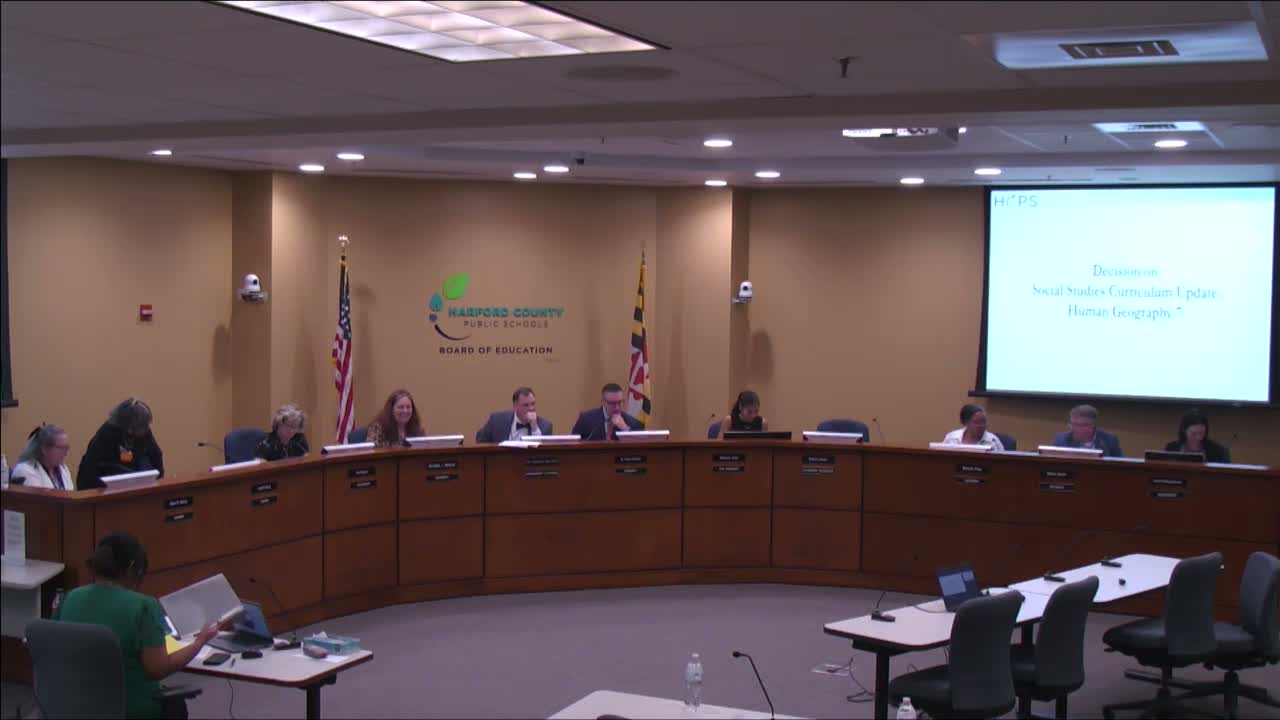
Summary
After extended public comment and board scrutiny, Harford County Public Schools staff agreed to edits and the board voted to postpone a final vote on the Grade 7 human geography curriculum until its June 23 meeting.
Harford County Public Schools presented a locally developed Grade 7 human geography curriculum on June 9 and the board voted to postpone final approval for two weeks so staff can incorporate requested edits.
Curriculum staff said the course aligns the district with the Maryland State Department of Education (MSDE) 6–7 framework and is structured as a two‑year sequence (grade 6 followed by grade 7). Erin Lang, supervisor of social studies, said units center on enduring geographic understandings such as place and region, human movement, the spread of ideas and disease, and a culminating regional case study that would let students produce a public exhibit for the Harford County Historical Society. The district reported a one‑time development cost of $31,073 and an estimated $9,000 for teacher professional development in 2025–26.
The presentation prompted sustained public comment and board member scrutiny about perceived framing and balance. Members of the public and several board members objected to passages characterized as "teacher‑facing" language that some said could push a particular narrative. Board member Miss Coker (speaker 5) said portions of the materials read as a single perspective and asked staff to ensure multiple viewpoints and clearer objectives rather than prescriptive narrative.
Curriculum writers said materials include guided routines (for example, "see, think, wonder" and "six thinking hats") intended to surface multiple perspectives; they also agreed to remove or revise teacher‑facing language the board flagged. "We intentionally gave students two contrasting treaties," the social studies team said, noting the lessons include structured activities designed to help students compare primary sources and reach their own conclusions.
Following discussion, board member Miss Alvarez moved to postpone final action until the June 23 board meeting so staff could incorporate the requested changes; the motion was seconded and carried after a roll call that recorded five members voting to table and five opposed. The board recorded a student‑member preference that gave effect to the tabling motion. Staff committed to provide the revised curriculum to the board within the week.
The district said it plans a phased implementation in 2025–26 with summer "sneak peeks," paid planning time for teachers, and follow‑up support including teacher‑leader planning and regular monitoring through teacher surveys and class visits.
The board will reconsider the revised curriculum at its next business meeting on June 23.