Get Full Government Meeting Transcripts, Videos, & Alerts Forever!
Get email alerts on the Multilingual Learners topic
No spam. Unsubscribe anytime.
Board hears progress report on multilingual learners as enrollment rises to about 13,000
Summary
Baltimore County Public Schools officials told the board that multilingual learner enrollment has increased by about 3,000 over four years to a little over 13,000 students and said aligned curriculum, decentralized ESOL staffing and targeted supports have improved exit rates on WIDA assessments.
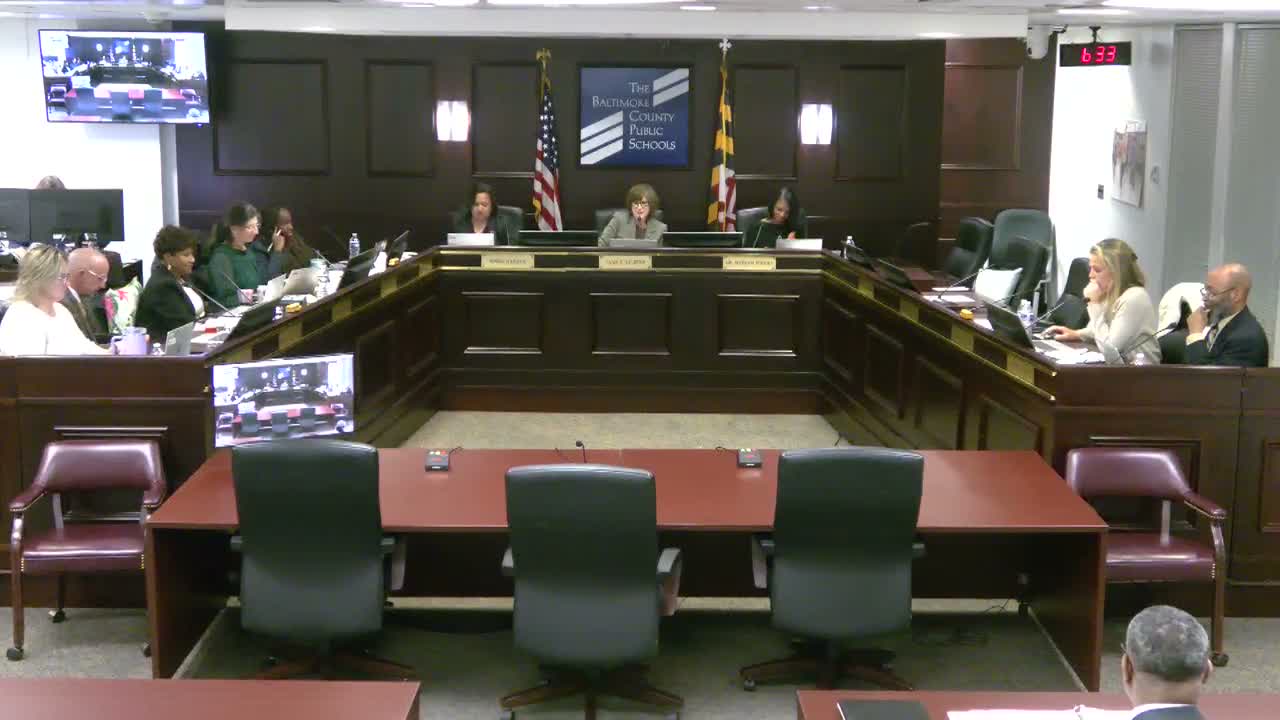
The Baltimore County Board of Education on Tuesday heard a data-driven update on services and outcomes for multilingual learners in the county.
District officials said enrollment of multilingual learners has risen by roughly 3,000 students over four years to "a little over 13,000" countywide and that the system has decentralized ESOL supports so students receive instruction in their home schools. Director Blotner highlighted expanded language services, use of TalkingPoints and interpreters for family outreach and pilots of new screening tools in elementary schools.
"We are excited to be here today to provide you an update on our multilingual learners and the achievement that they're making in Baltimore County Public Schools," a presenter said. Staff described increased exit rates from English language development programs and noted the state exit criterion as an overall WIDA score of 4.5.
Board members pressed for details about specific challenges. Officials identified secondary "newcomer" students who are under-credited or have interrupted education as a pressing concern, explained that chronic absenteeism often reflects work or family circumstances, and said the district will form a work group to explore multiple pathways for older multilingual students, leverage community-school partnerships and study CTE access for newcomers.
Officials described typical timelines for language acquisition, saying the goal is that most students exit the ELD program within about four to five years (with six years as a maximum in some cases), and said reading and writing often present the slowest progress toward exit. They also committed to providing more precise comparative data on academic performance for students who have exited ELD versus those still enrolled.
Next steps include continuing the curricular alignment to grade-level standards, expanding professional development and coaching for co-teaching models, and creating a work group to design strategies for under-credited secondary students. The presenters said they will return with more granular data and specific proposals for the board to review.