Get Full Government Meeting Transcripts, Videos, & Alerts Forever!
Get email alerts on the Environment Conowingo topic
No spam. Unsubscribe anytime.
Maryland, Constellation settlement promises $341 million for Conowingo‑related Bay projects; counties seek details on dredging
Summary
Maryland Department of the Environment officials told Dorchester County the revised Conowingo Dam water quality certification and settlement would secure $341 million in environmental projects over 50 years, including a $19 million dredging reserve; county leaders pressed MDE on how and when large‑scale dredging could proceed and on county input into modification rights.
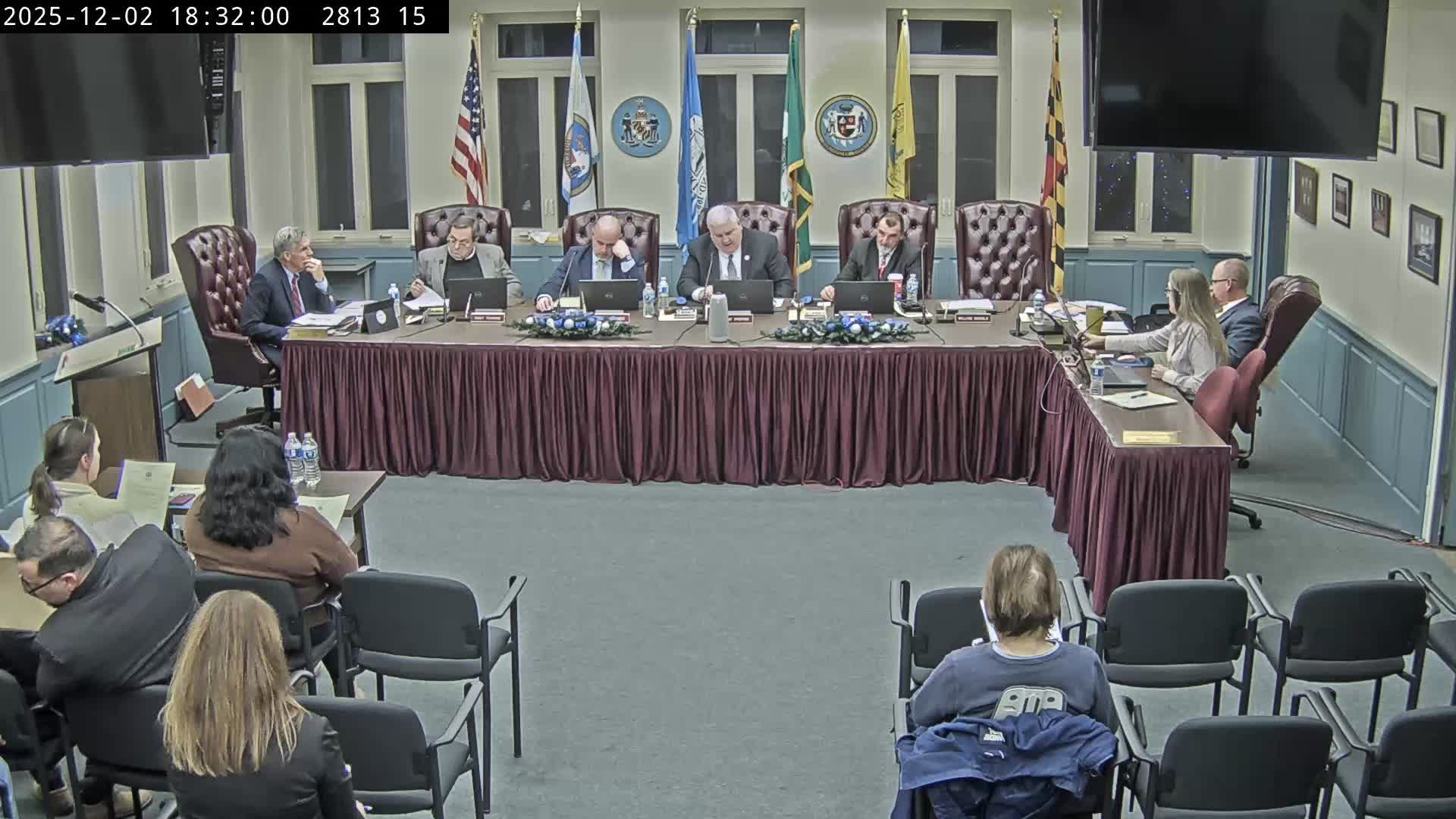
Dorchester County — Maryland Department of the Environment (MDE) officials on Tuesday briefed Dorchester County Council on a revised water quality certification (WQC) and settlement tied to the Conowingo Dam that they said would yield $341,000,000 in environmental investments over the 50‑year licensure period.
Edward Hughes, deputy secretary at MDE, told the council the package includes $88 million for water‑quality and resiliency projects, $78 million for trash and debris removal, $28 million for eel and fish passage work, $23 million to build and operate a freshwater mussel hatchery, $9.4 million for invasive‑species control and nearly $19 million allocated for dredging studies and feasibility work. “There’s $341,000,000 worth of projects and investment,” Hughes said.
The settlement, negotiated confidentially with Constellation Energy and environmental litigants including the Chesapeake Bay Foundation and Waterkeepers Chesapeake, accompanies an MDE revised WQC that the agency says includes about 50 pages of enforceable conditions. Heather Nelson, wetlands and waterways protection program manager in MDE’s Water and Science Administration, said many protections become actionable only when FERC issues a new federal license. “None of these improvements take effect until FERC issues the new license,” Nelson said.
Why it matters: county officials said the Conowingo Dam’s sediment and nutrient loads affect local waterways and that timely action is critical. The dredging reserve prompted the most questions. Multiple councilmembers said the $19 million earmarked for dredging studies over 25 years is small compared with prior large‑scale estimates for removing sediment from behind the dam. “One big rain event could roll back a lot of the progress,” a councilmember said.
MDE’s response emphasized staged work rather than an immediate large‑scale dredge. Nelson outlined a three‑step pathway: (1) modeling led by the U.S. Army Corps of Engineers (cost‑shared with MDE) to be delivered by late 2026, (2) feasibility and economic analysis funded from the dredge reserve to assess whether dredging can be made financially viable and to qualify dredging in the Chesapeake assessment model, and (3) implementation if engineering and permitting show dredging is feasible. Nelson said the $19 million secures stability for planning and can leverage federal matching funds but is not intended to fund a single, full‑scale dredge.
Council concerns centered on two legal points: the length of the requested 50‑year FERC license and a settlement clause described by some members as a broad “modification” provision they worry could limit Maryland’s future leverage. Hughes said FERC sets the license term and MDE can petition for modifications and adaptive management under section 401 processes but acknowledged the wording requires careful review.
The state officials repeatedly urged continued county engagement in implementation. Hughes said several projects are front‑loaded so local improvements should begin before mid‑term, but he cautioned that legal challenges or delays in the FERC licensing process would pause payments and stall many projects. “If there’s litigation, all payments for mussel restoration, dredging analysis and mitigation projects are stayed while there’s any challenge,” Nelson said.
What’s next: MDE said the Army Corps’ three‑dimensional sediment‑transport modeling due in 2026 will be pivotal for determining dredging benefits and for advancing feasibility work that could unlock larger federal dollars. MDE officials offered to follow up with county requests for clarifications about the settlement’s modification language, consultation requirements and the confidentiality of negotiations.
The council did not take a formal vote on the settlement; members thanked the MDE delegation and emphasized they want continued dialogue and clearer drafting on modification and consultation processes before endorsing implementation steps.
Sources: Presentation and Q&A with Edward Hughes, Deputy Secretary, Maryland Department of the Environment; Heather Nelson, Wetlands and Waterways Protection Program Manager; public remarks and council questions at the Dorchester County Council meeting.