Get Full Government Meeting Transcripts, Videos, & Alerts Forever!
Get email alerts on the Planning Community Plans topic
No spam. Unsubscribe anytime.
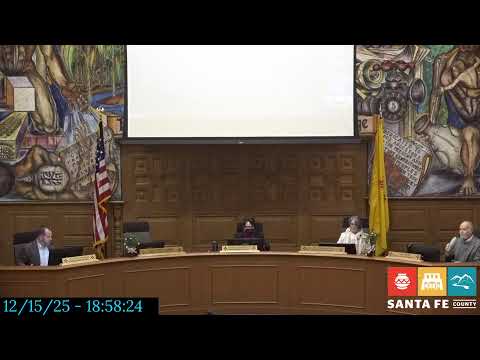
Santa Fe commissioners table La Cienega community plan, ask staff and community for five actionable near‑term priorities
Summary
After a lengthy public hearing and robust community testimony, the board voted to return the La Cienega community plan with five community‑identified, actionable priorities (short/medium/long term) so the county and legislators have a concise list of fundable items to pursue.
Santa Fe County commissioners paused final adoption of the La Cienega community plan update Dec. 12 and directed planning staff and community representatives to identify five near‑term, actionable priorities the board can carry forward to budgeting and legislative discussions.
Planning staff presented the updated plan, which modernizes maps, adds detailed implementation matrices and updates public‑transit notes to reflect new MyBLUE on‑demand service. The draft preserves many 2015 goals while adding new sections and implementation detail. Planning Manager Brett Clavia and staff emphasized the work invested in community mapping and an implementation matrix intended to guide capital and regulatory work.
Community testimony: Multiple long‑standing community leaders urged the board to protect agricultural character, prioritize PFAS remediation and water‑line extensions, and activate the county’s transfer‑of‑development‑rights (TDR) bank to preserve ranchland. JJ Gonzalez, who led community efforts, said the planning committee included nearly 60 members and identified 15 priorities in the matrix; Alonso Gallegos (Tres Rios Ranch) asked the county to accelerate TDR implementation. "We had about 60 members that participated in upgrading this plan," Gonzalez said. Dolores Baca and other residents emphasized downstream water impacts and urged county support.
Board discussion and action: Commissioners praised the plan’s comprehensiveness but said the county needed a concise list of community priorities that are fundable and actionable within five years (for example: funding a PER for a water project, a preliminary engineering design for a roundabout or a targeted remediation plan for PFAS contaminated wells). Chair Camilla Bustamante proposed — and the board approved — returning with five community‑identified priorities, rather than adopting the full plan tonight. The vote to table/return the plan directed staff to work with the planning group to produce that brief, actionable list for the board’s consideration.
Why this matters: The plan identifies long‑term projects (water infrastructure, PFAS remediation, land‑use protections, road safety, and community facilities). Commissioners and residents said a distilled, prioritized list will help match community needs to capital outlay, memorial, ICIP and internal county budget opportunities in the coming legislative and budget cycles.
Next steps: Planning staff and the community planning group will convene to select and document five priorities — short‑term, medium‑term and long‑term — and return those to the board for incorporation into ICIP and legislative outreach.