
Swanzey selectmen continue public hearing on $500,000 CDBG request for Plainview senior housing
Get AI-powered insights, summaries, and transcripts
Subscribe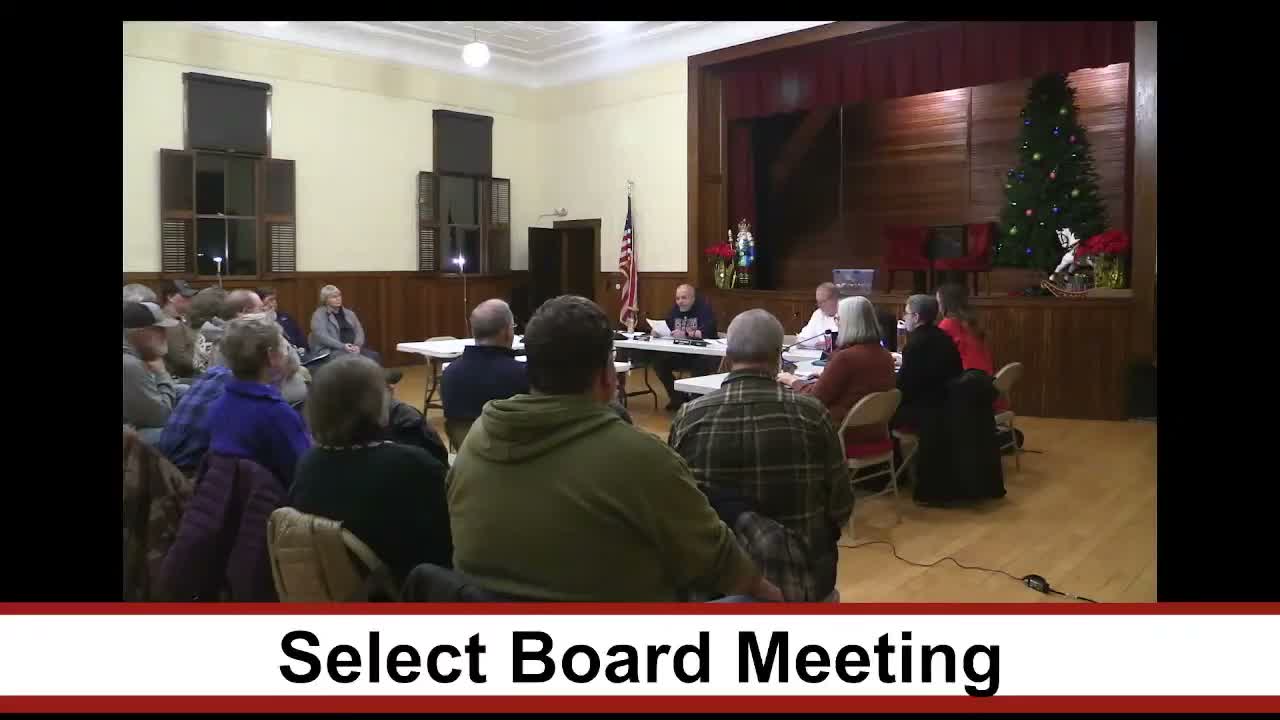
Summary
Selectmen heard a public hearing on a proposed $500,000 CDBG award (about $30,000 admin, $470,000 to be loaned) to Plainview Senior Limited Partnership for a 74-unit senior housing project at 115 Old Homestead Highway; residents pressed the board for details on oversight, the compliance period, and local impacts. The board continued the hearing to Jan. 14 for more information.
The Swanzey Board of Selectmen reopened a public hearing Dec. 23 to consider the town’s support for a Community Development Block Grant (CDBG) application that would provide up to $500,000 in federal-state funds through the Community Development Finance Authority to support Plainview Senior Limited Partnership’s proposed 74-unit senior housing project at 115 Old Homestead Highway.
Jack Franks, who identified himself as general partner of Plainview Senior Housing, told the board that the town would retain $30,000 for administrative costs and that up to $470,000 would be loaned to the development and held with the project during the compliance period. “The town receives that back from the development project after the initial term of the compliance period,” Franks said, describing the grant as bridge financing the developer would repay to the town after federal/state compliance terms expire.
Residents questioned how long the town would wait to see those funds returned, who would monitor compliance, and whether accepting the grant would limit the town’s ability to pursue other grants or obligate town staff. Jay Ward asked for clarity about the amount, saying, “It it says up to, $500,000. Do we we don't know exactly how much is gonna be the grant's gonna be, or is it gonna be for 500,000?”
Other public commenters raised community-capacity concerns. George Hoffman asked whether a market study had demonstrated Swanzey’s local need, saying, “Has there been any study that would indicate our need for elderly housing?” Franks responded that multiple market studies showed strong regional demand and that the project’s market area would encompass the immediate site and surrounding areas.
Speakers pressed two additional points the board said it needed clarified before any decision: (1) monitoring and enforcement — which state agencies would oversee compliance and how the town would verify terms — and (2) timing and risk — how long the town would be without access to the loaned funds (Franks said tax-credit compliance and amortization commonly involve a 15-year initial compliance window, with land-use restriction terms that can be longer). Concern was also expressed about optics and conflicts: at least one resident asked why the town would assist a developer that is litigating with town boards; Franks said the entities were separate and the housing application stood alone.
Board members and staff told residents they had significant unanswered questions and would not vote that night. The board voted to continue the public hearing to Jan. 14 at 6:00 p.m., asking staff to assemble specific written questions for the applicant’s consultant and state contacts on compliance terms, monitoring, the Community Development Finance Authority rules (including whether an eligible community-based development organization is required for new construction in the CDFA program), and any constraints on future town grant applications.
The hearing on the CDBG application will resume Jan. 14, when the board expects to receive written clarifications from town staff and from the applicant’s consultant.